The first time I arrived in Berlin, it was winter and I was underdressed.
Not physically — I had layers. Emotionally.
Berlin in 2015 felt like a test I hadn’t studied for. We biked through frozen air to celebrate New Year’s Eve with friends who had already assimilated into the city’s particular rhythm. The streets were gritty and glamorous in equal measure. We tried too many kinds of vodka. I learned, quickly, that Berlin’s unofficial dress code for the hip and nocturnal was monochrome — black on black, preferably with a degree of studied indifference.
I, unfortunately, was not monochrome.
I was optimistic. Which is worse.
There is a particular humiliation in realizing you’ve shown up to a cultural moment wearing the wrong mood. Berlin does not apologize for itself. It doesn’t soften the edges. It dares you to adjust.
Five years later, I returned — older, softer, with a child in tow — and the city felt different. Or maybe I did.
Friends had migrated north-east to Prenzlauer Berg, that once-alternative neighborhood now gently colonized by playgrounds and organic bakeries. If early-2000s Berlin was techno and concrete, Prenzlauer Berg today feels almost Parisian in its symmetry — broad streets, trees that arch politely over sidewalks, cafés with prams parked outside like punctuation marks.
Berlin contains multitudes. That is its charm and its contradiction.
I asked about vintage shops in the area, because wherever I travel, I measure a city partly by its relationship to secondhand clothing. Thrift stores reveal what a place discards. Vintage boutiques reveal what it chooses to preserve.
Two names surfaced. Humana — an actual secondhand department store, industrial in scale — and Vintage Revivals.
I only made it to the latter.
And I am glad I did.
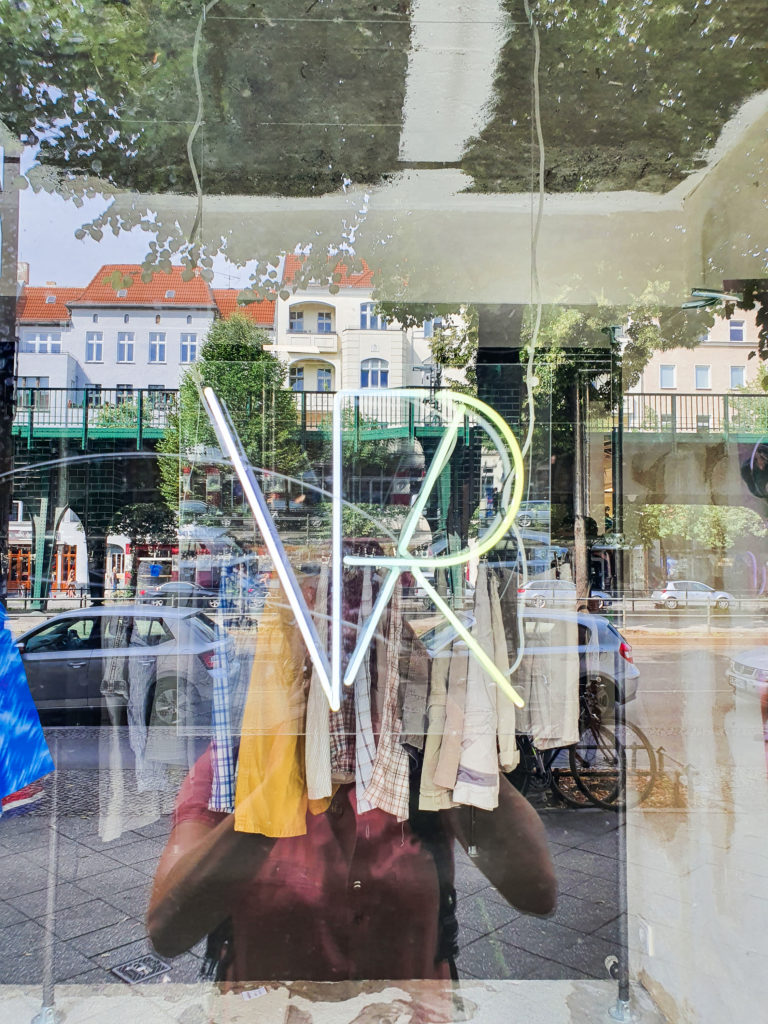
The Shock of Color in a City of Black
If Berlin has an aesthetic stereotype, it’s minimal. Stark. Black denim and leather and utilitarian silhouettes that whisper, I don’t care what you think, but I know exactly what I’m doing.
Vintage Revivals does not whisper.
It beams.
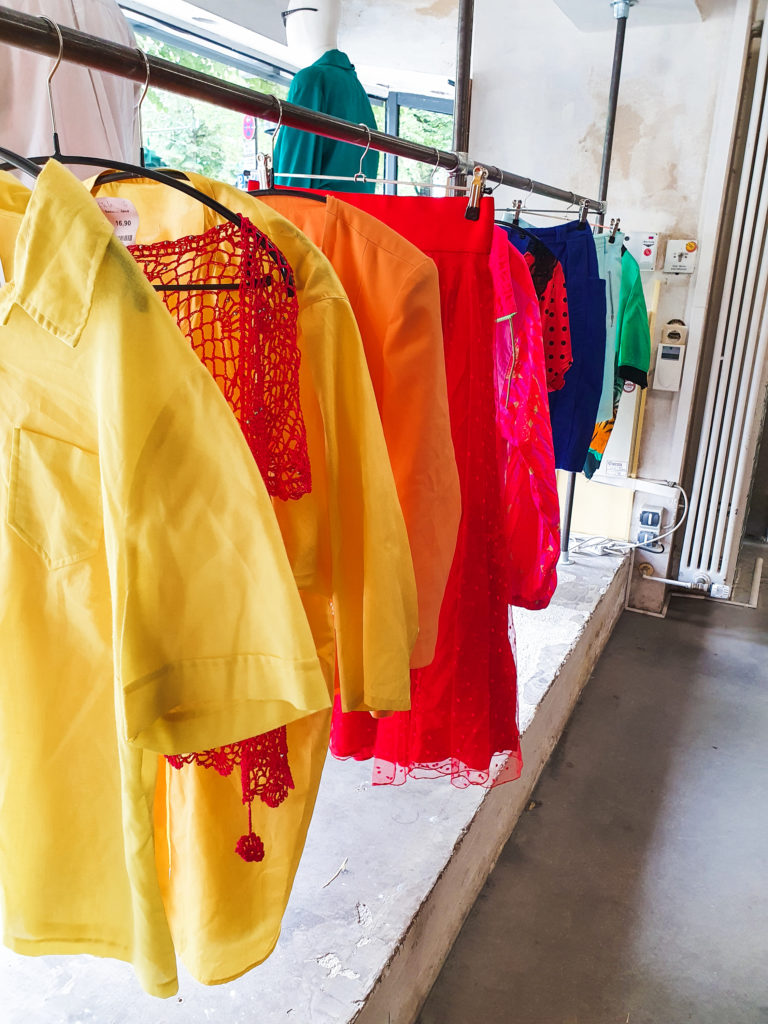
Walking into the store felt like stepping through a chromatic portal. Outside: concrete grey. Inside: saturated yellows, peachy pinks, electric blues, patterns that refused to blend into walls.
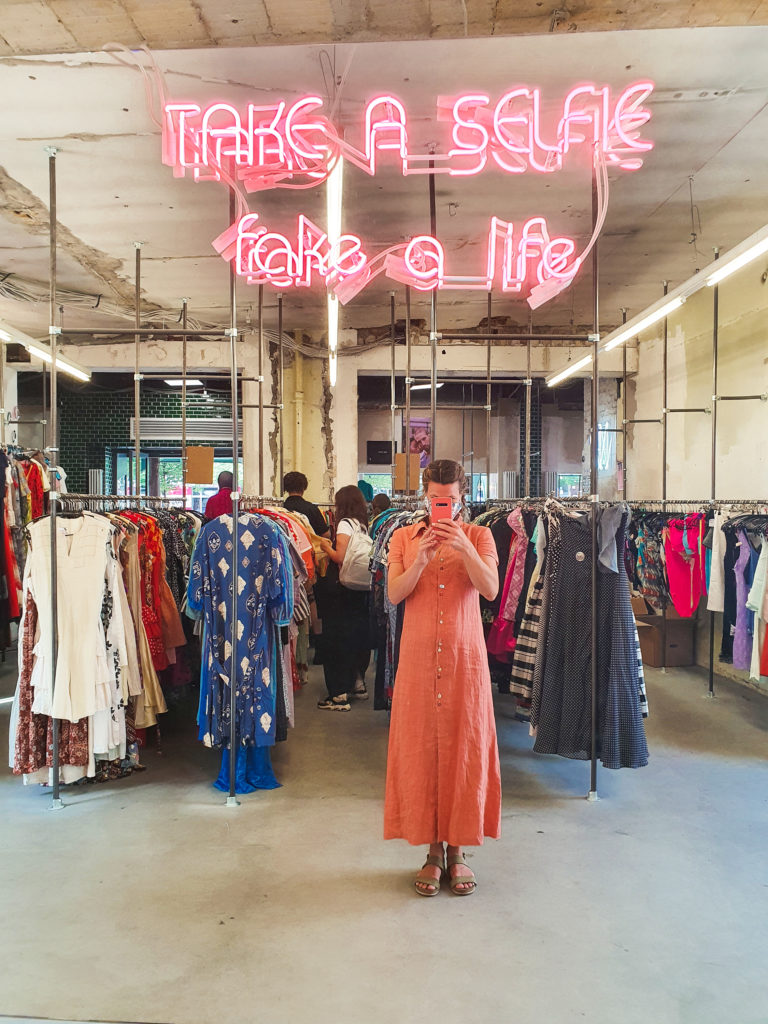
The space itself is urban and raw — concrete floors, industrial lighting, music slightly too loud for someone who now owns noise-canceling headphones for toddler reasons. The staff look like they could breeze through Berghain’s famously unforgiving door without a flicker of anxiety. All cheekbones and black eyeliner and the kind of cool that appears effortless but is probably highly curated.
And yet, against that austere backdrop: racks bursting with color.
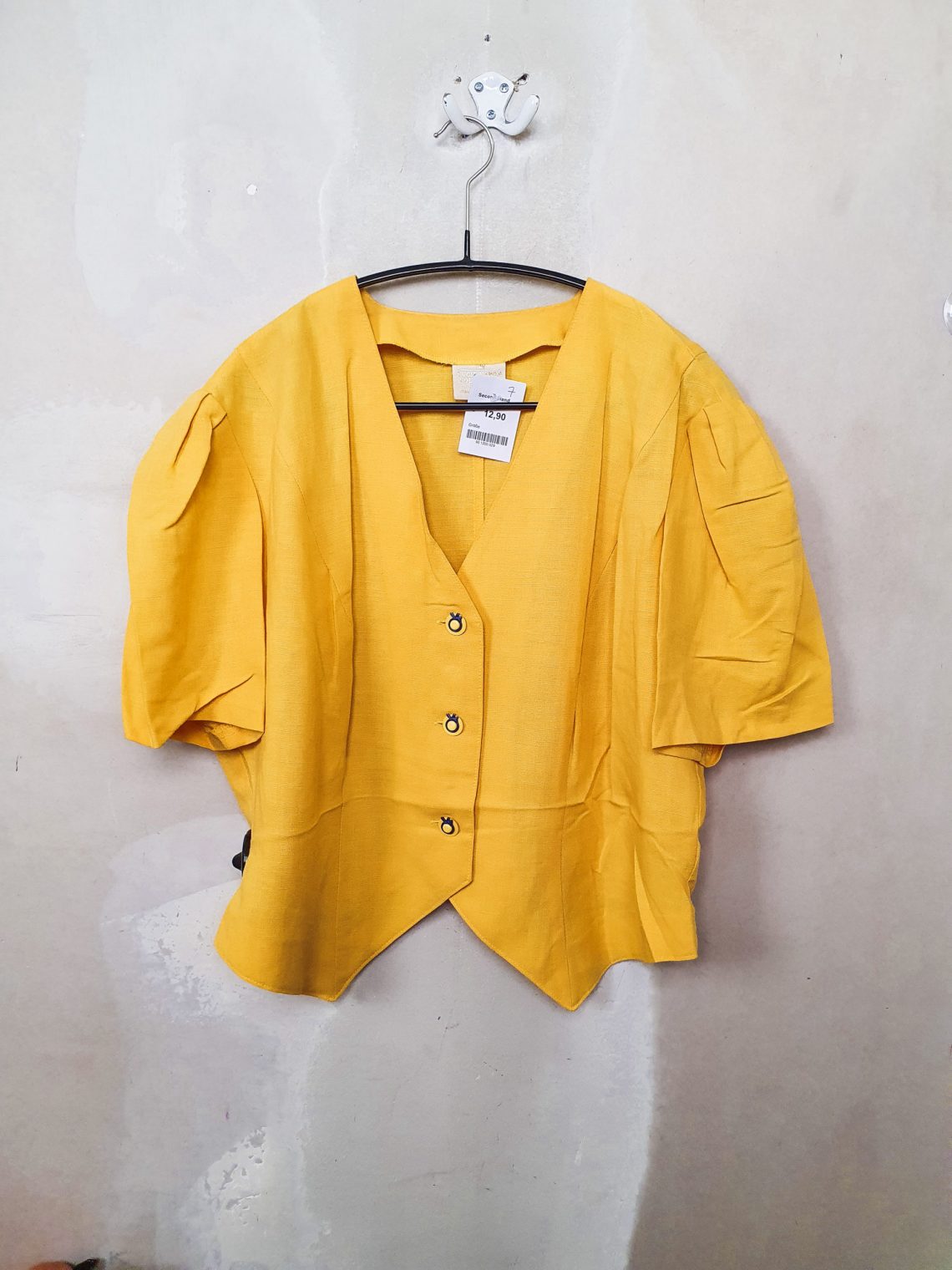
Canary-yellow cropped hoodies. Peach skirts with architectural pleats. Hawaiian shirts that feel less ironic and more defiant. Butter-soft knits from the ’80s. Sixties silhouettes with exaggerated collars. A gothic corner that leans heavily into lace and drama.
If Berlin outside often feels disciplined, Vintage Revivals feels mischievous.
Thrifting Without the Dirt Under Your Nails
I am not intimidated by thrift stores.
I have dug through literal bins. I have inhaled that faint, inescapable scent of pre-loved textiles. I have held garments up to fluorescent lighting and squinted at stains like a detective.
There is a particular thrill in treasure hunting through chaos.
Vintage Revivals, however, is not chaos.
It is curated.
The racks are organized by color, by era, by type. The chaos is aesthetic, not logistical. You don’t need patience so much as curiosity.
This distinction matters.
Berlin’s thrift culture is vast and democratic. Humana, for example, operates almost like a secondhand supermarket — rows and rows of garments, priced accessibly, turnover constant. It mirrors Berlin’s broader ethos: resourceful, communal, pragmatic.
Vintage Revivals, by contrast, feels more editorial. The pieces are chosen. Elevated. Slightly more expensive, but not inaccessible. It’s less about rummaging and more about discovering.
This reflects a larger shift in global secondhand culture. Thrifting used to be either necessity or subcultural rebellion. Now it occupies a curious middle ground — both ethical stance and aesthetic pursuit.
In cities like Berlin, that shift feels amplified. Sustainability here isn’t a trend. It’s infrastructure. Public transport works. Recycling is ritualized. Repair culture still exists.
Vintage fits naturally into that ecosystem.
The Fitting Room Reckoning
There is a universal truth about vintage clothing that no one romanticizes enough:
What looks transcendent on the rack can look absurd on your body.
Vintage Revivals is not exempt from this law.
I carried armfuls of possibility into the fitting room. Structured blazers with shoulder pads that whispered “1987 power lunch.” A pleated skirt in a shade I can only describe as optimistic apricot. A boxy Hawaiian shirt that felt like summer rebellion in cotton form.
And then — the mirror.
Vintage cuts are different. Sizing is inconsistent. Fabrics drape in unfamiliar ways. The silhouette that made sense on someone in 1963 might feel theatrical on a modern body accustomed to stretch blends and strategic tailoring.
There is a moment — often several — where you stand in front of that mirror and think: what am I looking at?
Not in horror. In confusion.
Body dysmorphia, even in mild forms, has a way of creeping into vintage fitting rooms. The garment doesn’t behave as expected. It sits differently at the waist. It widens where contemporary fashion narrows. It demands posture.
Vintage clothing does not adjust to you.
You adjust to it.
That negotiation can be uncomfortable.
But it can also be illuminating.
The Two Pieces That Stayed
After several fitting-room identity crises, I found two pieces that felt less like costume and more like conversation.
A 100 percent linen dress — understated, breathable, with a silhouette that skimmed rather than clung. And a white top with butterfly sleeves that flirted with drama without tipping into parody.
Both were simple.
Neither screamed.
They didn’t fight my body. They collaborated.
There is something deeply satisfying about finding vintage pieces that don’t require irony to justify them. They don’t need to be styled into submission. They just work.
Perhaps that’s the hidden discipline of thrifting in a city like Berlin: discernment.
You don’t need the loudest piece. You need the right one.
Berlin’s Relationship With Reinvention
Berlin is a city that has rebuilt itself repeatedly.
War. Division. Reunification. Gentrification.
Layers of history sit visibly atop one another — brutalist structures next to restored facades, techno clubs housed in former power plants, art galleries in abandoned factories.
Vintage fashion mirrors that layering.
Each garment carries a prior life. A previous owner. A context that may no longer exist.
Buying vintage in Berlin feels especially poignant because the city itself is an archive.
Prenzlauer Berg, once gritty and alternative, now hosts stroller traffic and organic supermarkets. The rebellious edge hasn’t vanished, but it has softened.
Vintage Revivals exists within that transformation.
It offers nostalgia without stagnation. It invites you to play with the past without being trapped by it.
In a city that knows how to shed skins, that feels appropriate.
Dressing Against the City
What struck me most about Vintage Revivals was the audacity of its color in a city that often defaults to black.
There is something quietly radical about wearing peach in Berlin.
Or mint.
Or sunshine yellow.
In a landscape of monochrome coats and sleek boots, color reads as intentional dissent.
Not loud dissent. Joyful dissent.
And perhaps that’s why the store felt like a small rebellion. It allowed you to step outside the city’s aesthetic gravity without abandoning it entirely.
You could still pair that canary hoodie with black trousers. That apricot skirt with combat boots.
Berlin tolerates individuality — but it respects cohesion.
Vintage Revivals provides the former.
You supply the latter.
The Myth of Effortless Cool
There is a persistent myth about Berlin coolness: that it is accidental.
That the leather jacket was thrown on without thought. That the haircut happened spontaneously. That the layering is intuitive.
It isn’t.
Berlin style, like all style, is constructed.
Vintage Revivals makes that construction visible. The exaggerated shoulders. The bold prints. The theatrical collars. They remind you that fashion has always been performative.
But performance isn’t dishonesty.
It’s expression.
Trying on those garments, even the ones that didn’t work, felt like auditioning versions of myself. The goth-adjacent iteration. The retro-Parisian one. The candy-colored optimist.
Not all roles fit.
But trying them on was instructive.
Sustainability Without Sermons
What I appreciate about Berlin’s secondhand culture is its lack of sanctimony.
No one in Vintage Revivals handed me a pamphlet about fast fashion. No one moralized at the checkout.
And yet, the act itself — choosing pre-worn garments over new production — carries quiet environmental weight.
In a fashion industry responsible for staggering levels of waste and emissions, extending a garment’s life is not insignificant.
But perhaps the more powerful shift is psychological.
When you buy vintage, you detach slightly from trend cycles. You engage with history. You accept imperfection — a slightly faded hem, a fabric that has softened with time.
You step out of the algorithm.
And in a world increasingly mediated by algorithms, that feels almost rebellious.
Leaving With Less Than I Wanted
There is a temptation in stores like Vintage Revivals to overindulge.
So much color. So much possibility.
But I left with just two pieces.
And that restraint felt good.
Because vintage shopping is not about accumulation. It’s about curation.
The city outside remained grey and grounded. Parents pushed strollers past graffiti walls. Cafés buzzed with low conversation.
I carried a linen dress and a butterfly-sleeved top back into that landscape.
They didn’t clash with Berlin.
They conversed with it.
Would I Go Back?
Absolutely.
There is something addictive about spaces that invite you to reimagine yourself without demanding reinvention.
Vintage Revivals is not a dusty thrift cave nor a sterile concept store. It sits somewhere in between — industrial shell, candy-colored interior.
It reflects Berlin itself: concrete exterior, creative interior.
And perhaps that’s the real reason it works.
Not because it is colorful.
Not because it is curated.
But because it understands contrast.
Berlin thrives on contrast.
So does good style.
And sometimes, stepping into a room full of peach skirts and canary hoodies in a city famous for black is exactly the reminder you need:
You don’t have to match the dress code to belong.
You just have to find the pieces that feel like yours.