We talk a lot about what’s wrong with fashion.
And rightly so.
Overproduction. Microplastics. Rivers turned chemical blue. Garment workers paid less than the price of the coffee we carry while scrolling through “new arrivals.”
Awareness matters. Without it, nothing shifts.
But if we only stare at the wreckage, we miss something else happening—quieter, more experimental, almost sci-fi. In labs, in small start-ups, in university research departments that smell faintly of solvents and ambition, people are trying to reimagine what clothing can be made of.
And not in a vague “organic cotton is better” way.
I mean: leather grown without animals. Silk brewed by microbes. Textiles spun from seaweed.
It sounds like a Pinterest board curated by a futurist who drinks matcha and talks about Mars colonies.
And yet, some of it is already here.
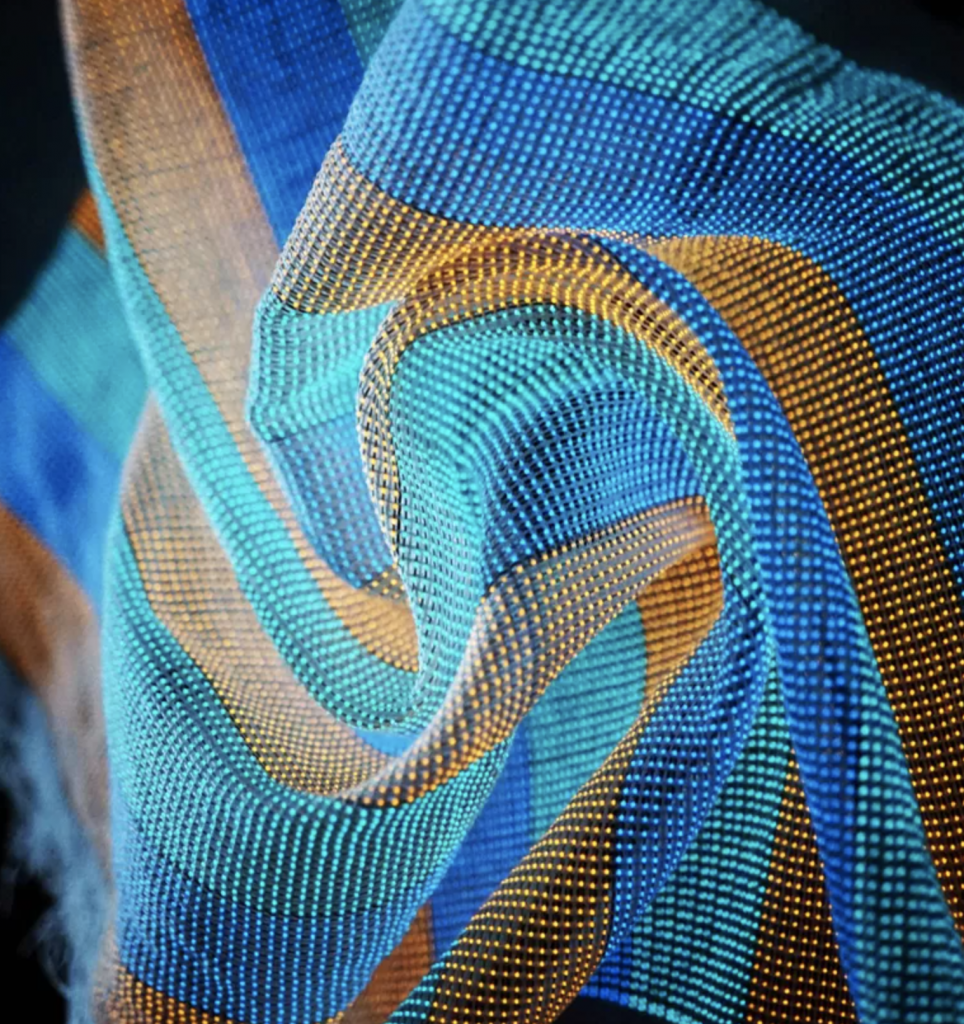
I own a turtleneck made from eucalyptus pulp. A friend of mine wears sneakers made from apple waste. Another swears by kelp-based fibers that feel like silk but behave like performance fabric.
For years, sustainable fashion felt like an aesthetic compromise. Beige. Linen. Slightly crunchy.
Now, it feels like biotechnology.
And that shift fascinates me—not only as someone who loves clothes, but as someone who believes fashion is one of the most revealing mirrors of our time.
Because textiles have always reflected power, trade, empire, innovation.
Cotton shaped colonial economies. Silk routes shaped continents. Polyester reshaped post-war consumerism.
So when new materials emerge, they’re not just “cool fabrics.” They signal tectonic shifts in how we value life, waste, labor, and desire.
Let’s talk about three of them.
Not as trend forecasts. But as cultural signals stitched into fiber.
1. Lab-Grown Leather: Rewriting a 7,000-Year Habit
Leather is one of humanity’s oldest materials.
For millennia, it symbolized durability, utility, status. It was armor, saddle, shoe, luxury handbag. The smell of leather became shorthand for craftsmanship.
And because it has been around so long, we rarely question it.
We tell ourselves it’s a byproduct of the meat industry. That it would “go to waste” otherwise. That Italian stamps guarantee quality, perhaps even ethics.
But leather is not neutral.
More than a billion animals are killed for leather each year. The industry is financially significant enough to sustain itself—not a mere leftover of meat production. It requires enormous amounts of water, land, energy. The tanning process often involves toxic chemicals. In poorly regulated regions, tannery workers face severe health risks, with some studies showing dramatically elevated cancer rates.

And then there’s the geographic opacity. A bag stamped “Made in Italy” may have been finished there, but the raw hide likely originated elsewhere—Bangladesh, India, China—where animal welfare and environmental regulations vary widely or are weakly enforced.
We comfort ourselves with branding.
But branding doesn’t erase chemistry.
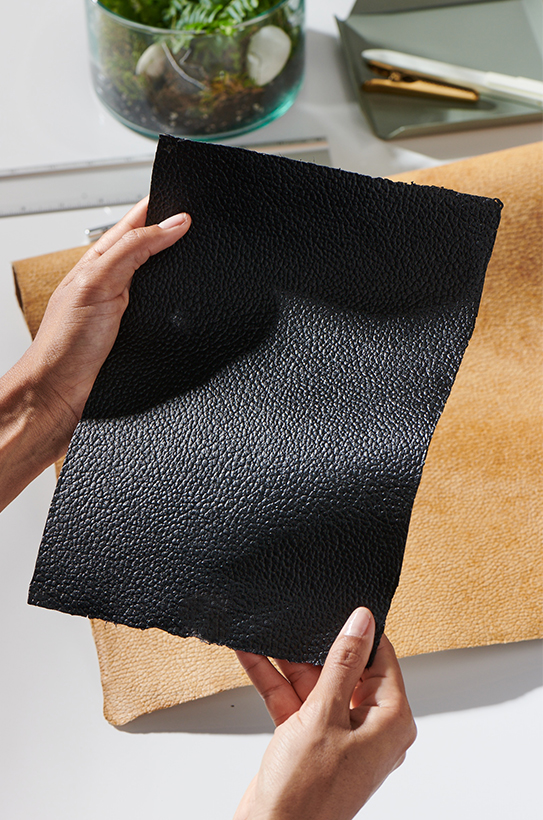
Enter lab-grown leather.
This is not “vegan leather” in the plastic sense. Not polyurethane pretending to be hide. Not petroleum masquerading as ethics.
This is collagen—grown.
Scientists have learned to reprogram the self-assembly of collagen molecules (the protein that gives animal skin its structure) and cultivate them in controlled environments. The result: a material that behaves like leather—soft, durable, flexible—but without raising or slaughtering animals.
No herds. No feedlots. No death marches.
Just cells, scaffolding, time.
The first time I read about this, I had to sit with it.
Because leather carries emotional weight. It’s sensual. It ages beautifully. It smells like tradition.
Can a lab replicate that poetry?
Maybe not immediately.
But perhaps we need to redefine what poetry means.
Historically, luxury has been intertwined with scarcity—exotic skins, rare animals, difficult supply chains. What if future luxury is defined by precision and restraint instead? By the ability to engineer material without extraction?
Lab-grown leather isn’t just a cruelty-free alternative. It’s a philosophical pivot.
It suggests that we no longer need to anchor beauty to harm.
And culturally, that’s seismic.
2. Bio-Fabricated Silk: When Microbes Become Designers
Silk has always been romantic.
It conjures empires, delicate hands, secret cocoons. For centuries, it was so valuable that knowledge of its production was guarded like state intelligence.
But traditional silk requires silkworms—boiled alive to preserve filament length.
Again, we inherited the method and rarely interrogated it.
Bio-fabricated silk changes the equation.
Through fermentation, scientists can program yeast or bacteria to produce silk proteins. These proteins are then spun into fibers that mimic the properties of spider silk or traditional silk—stronger than steel by weight, lightweight, lustrous.
Imagine brewing silk the way we brew beer.
This sounds like science fiction. But companies have already developed prototype garments and accessories using this method.
The cultural implications are fascinating.
Fermentation is ancient. Humans have used microbes for bread, wine, cheese. Now we’re asking them to produce couture.
It collapses the distance between biology and design.
And it reframes fashion from something extracted to something cultivated.
There’s something almost tender about that.
Instead of raising animals for fiber, we collaborate with microorganisms. Instead of fields and feed, we use controlled vats. Instead of seasonal harvests, we potentially create materials on demand.
Of course, scale and cost remain challenges. Industrial adoption takes time. Infrastructure needs to shift. Investors need convincing.
But what excites me is the conceptual leap.
Silk no longer belongs exclusively to worms and luxury houses.
It becomes programmable.
And once a material is programmable, design itself changes. Strength, elasticity, texture—these variables can be tuned at the molecular level.
Fashion, historically, has manipulated silhouette and surface.
Now it may begin manipulating protein.
If that doesn’t make you pause mid-scroll, I don’t know what will.
3. Seaweed & Algae Textiles: Wearing the Ocean (Gently)
Seaweed doesn’t scream “wardrobe staple.”
It screams sushi. Tide pools. Slippery rocks at low tide.
And yet, algae and kelp are quietly becoming one of the most promising textile sources.
Seaweed grows rapidly. It requires no fresh water, no pesticides, no arable land. It absorbs carbon dioxide as it grows. Some species even help restore marine ecosystems.
When processed into fiber—often blended with other materials—seaweed-based textiles can be breathable, soft, and surprisingly skin-friendly. Some versions even retain trace minerals that are said to have soothing properties (though we should always be cautious with wellness claims).
The first time I touched a seaweed-blend fabric, I expected something rough. It felt closer to silk or modal.
There’s something poetic about that transformation: from ocean plant to tailored garment.
But beyond poetry lies infrastructure.
Textile agriculture has long competed with food production for land and water. Cotton is notoriously thirsty. Polyester relies on fossil fuels.
Seaweed bypasses these constraints.
It doesn’t solve everything—processing still requires energy, blending complicates recycling—but it introduces a radically different starting point.
Culturally, seaweed textiles challenge our imagination of “natural.”
For decades, sustainable fashion leaned heavily on pastoral imagery: organic cotton fields, sheep grazing, linen drying in the sun.
Seaweed pulls us offshore.
It expands the geography of fashion beyond farmland into marine ecosystems.
And that expansion matters. Because climate change is not only a land story. It’s an ocean story.
If textiles can support regenerative aquaculture—if fashion can incentivize healthier marine farming—we begin to link aesthetics with restoration.
That’s not a small shift.
The Emotional Resistance to Innovation
Here’s the part no one talks about enough.
Innovation alone doesn’t guarantee adoption.
Fashion is not purely functional. It’s emotional. Symbolic. Tribal.
Leather signals toughness. Silk signals luxury. Cotton signals comfort. Polyester signals sport.
When we introduce lab-grown collagen or algae fiber, we’re not just offering a new material—we’re asking people to update their symbolic vocabulary.
And humans resist symbolic disruption.
We’re attached to stories.
The story of leather is rugged masculinity and heritage craft. The story of silk is aristocratic refinement. The story of cotton is Americana and softness.
What is the story of bio-fabricated silk?
What is the mythology of seaweed?
We’re writing it in real time.
And that’s why these fabrics matter beyond their carbon footprint.
They force us to confront what we actually value in clothing. Is it the tactile experience? The status narrative? The ethics? The tradition?
If a lab-grown leather jacket feels identical to animal leather but carries a different origin story, which one do we choose?
If seaweed fabric performs beautifully but lacks centuries of romance, does that matter?
Perhaps we’re entering an era where material literacy becomes as important as brand literacy.
Where knowing what something is made of carries as much cultural capital as knowing who designed it.
Hope, But Not Naïveté
It would be easy to end here with optimism.
But innovation is not immune to capitalism.
New materials can be co-opted. Greenwashed. Overproduced.
A lab-grown leather handbag is not automatically sustainable if it’s produced in massive quantities and discarded after five wears.
Bio-fabricated silk doesn’t neutralize overconsumption.
Seaweed fiber doesn’t absolve us from buying thoughtfully.
Technology can reduce harm. It cannot fix appetite.
And yet, I remain cautiously hopeful.
Because these materials represent intention.
They suggest that instead of simply optimizing existing harm, we’re rethinking foundations.
For decades, fashion innovation focused on speed and cost efficiency. Now, at least in certain corners, innovation is turning toward biology, circularity, regeneration.
That pivot feels significant.
When I look at my wardrobe now, I see a timeline.
Cotton tees. Polyester blends. A wool coat. An apple-leather accessory. A eucalyptus knit.
Each piece represents a technological moment.
Fashion is not static. It never has been.
The Industrial Revolution gave us mechanized weaving. The 20th century gave us synthetics. The 21st century may give us grown materials.
And perhaps the real mind-blowing part isn’t that we can grow leather or brew silk.
It’s that we’re finally questioning whether we need to keep doing things the way we always have.
For centuries, we accepted that beauty required extraction.
Maybe the next chapter of fashion will ask: what if beauty could be cultivated instead?
Not mined. Not slaughtered. Not drilled.
Cultivated.
If that’s where we’re heading, then yes—my mind is officially blown.