I used to believe celebration required a calendar notification.
A birthday. A wedding. A job promotion. Something official enough to justify lipstick at 9 a.m.
On ordinary Tuesdays, I wore black. Practical black. Efficient black. The kind of black that says, “I am not trying to be seen.” I told myself it was minimalism. Maturity. Professionalism. But if I am honest, it was a way of shrinking.
Then I met Chiara.
And Chiara does not shrink.
She expands. In color. In silhouette. In presence.
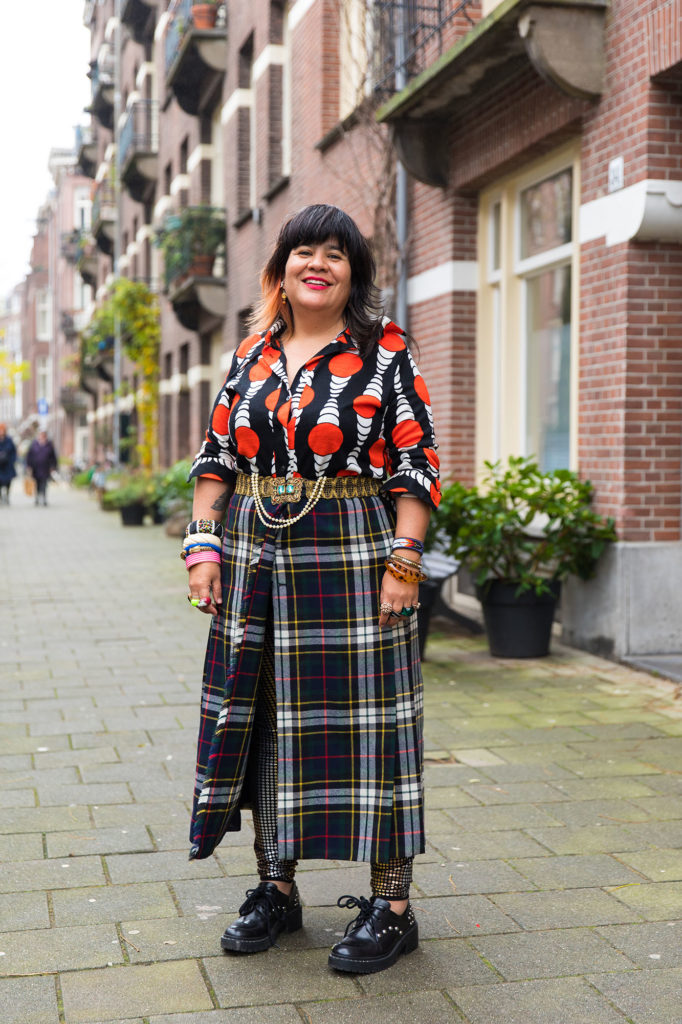
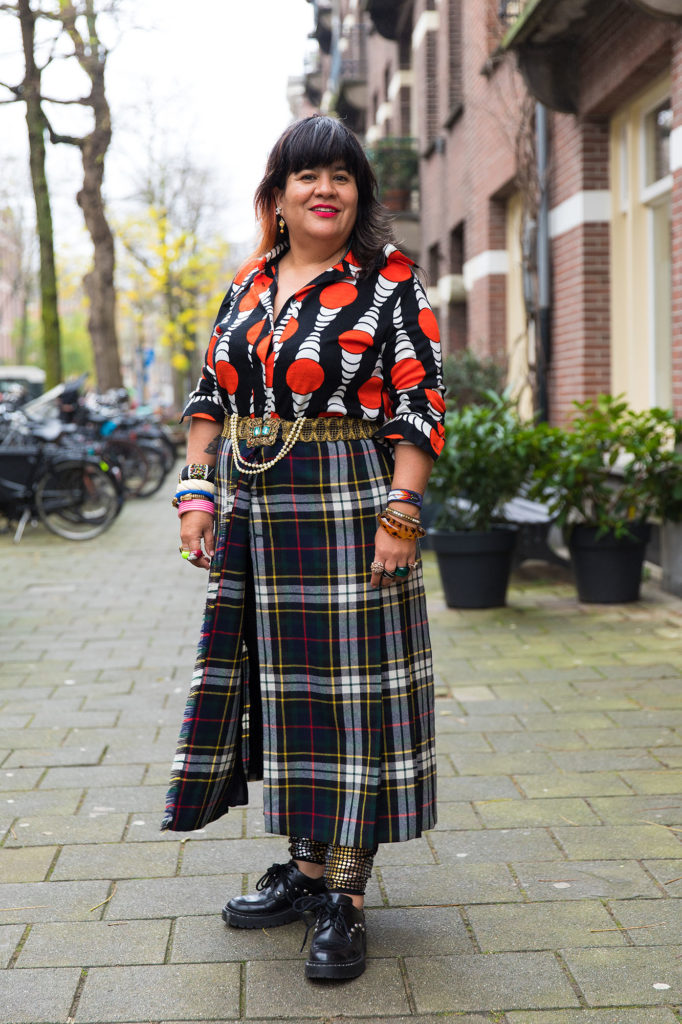
You can spot her from across the canal in Amsterdam: a citrus-orange coat in winter light, layered with lilac tights, a skirt that might once have been a scarf, rings that glint like tiny constellations when she gestures. She always looks as if she is heading somewhere important — a gallery opening, a birthday dinner, an opera. But sometimes she is just going for coffee.
“Why should special clothes wait for special occasions?” she asked me once, adjusting a blouse she was wearing back to front. “Isn’t being alive enough?”
It sounds simple. Almost naïve. And yet, standing next to her, I realized how radical that question is.
The Politics of Getting Dressed
Clothing has always been political. Not in the loud, slogan-on-a-T-shirt way (though that too), but in the quieter architecture of fabric and fit.
Throughout history, dress codes have dictated who could wear silk, who had to wear wool, who was allowed color, who was confined to black. From sumptuary laws in Renaissance Europe to Victorian corsetry, clothing has disciplined bodies and signaled belonging. To dress has always meant to position oneself in society.
And yet, somewhere along the way, especially for women, dressing up became tied to performance — for others. To be admired. To be evaluated. To be appropriate.
Chiara quietly refuses that script.
When she tells her clients that clothes are their “second skin,” she does not mean trend alignment. She means alignment with self. A garment should not disguise you. It should amplify you.
In her work as a style coach, she enters women’s wardrobes the way an anthropologist might enter an archive. She listens. She asks questions. She touches fabric like it carries memory — which it does.
“Shopping in your own closet,” she calls it.
At first, the phrase made me smile. It sounds like something a sustainability campaign would coin. But when I watched her at work, I understood it differently. It is not about saving money (though you do). It is not only about sustainability (though that matters deeply). It is about narrative.
Most of us own far more clothing than we consciously engage with. Pieces pushed to the back because we once wore them to an awkward date. A skirt we loved five years ago but no longer “feel like.” A blouse bought for a version of ourselves that never quite materialized.
Chiara sees none of that as failure. She sees material.
She will take that neglected skirt, fold it differently, tie it, layer it over trousers. Suddenly it is new. Or rather — it is revealed.
And in that act, something subtle happens: the past is not discarded. It is reinterpreted.
Memory in Fabric
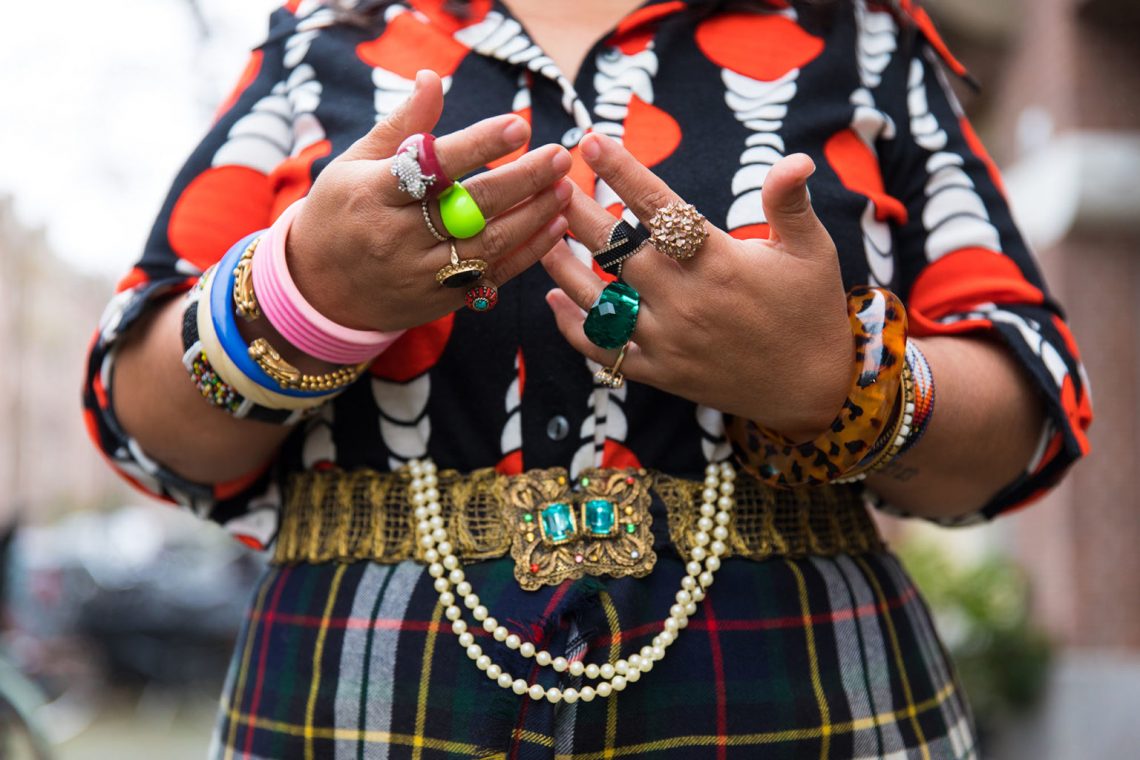
The belt she wore the day I visited her used to be a curtain tieback.
Her mother had noticed it one evening while getting ready for a party. The velvet cord, heavy and slightly theatrical, seemed too beautiful to hide against a wall. She looped it through her dress and left the curtains unattended.
It never returned to its original function.
Now Chiara wears it the same way. Not ironically. Not nostalgically. But as continuation.
There is something deeply European about this gesture — this refusal to separate everyday objects from aesthetic potential. In a culture that often prioritizes novelty, Chiara practices inheritance.
She wears a ring that belonged to her partner’s grandmother. Another was gifted by a friend of twenty years. One she found in a thrift shop for one euro. Together, they form a constellation of relationships around her fingers.
When she moves her hands, the past moves with her.
Roland Barthes once wrote about clothing as a system of signs. A coat is never just a coat; it signals class, season, mood, intention. But Barthes, with his structuralist clarity, perhaps underestimated the emotional sediment garments accumulate.
A sweater can hold the memory of a winter you survived. A dress can carry the echo of a room where you felt luminous.
Chiara does not archive these memories in boxes. She wears them.
Dressing as an Act of Self-Recognition
There is a quiet bravery in dressing up when no one expects you to.
It exposes you.
If everyone around you is in neutral tones and you appear in electric blue, you are visible. You cannot hide in the background of your own life.
I confessed to Chiara that sometimes I avoid color because I do not want to be “too much.” She laughed, not unkindly.
“Too much for whom?”
That question has lingered with me.
We learn early — especially as women — to calibrate ourselves. Not too loud. Not too bright. Not too ambitious. Not too dressed up. There is always a threshold beyond which enthusiasm becomes excess.
But who defines that threshold?
In a society that constantly asks us to optimize — our productivity, our bodies, our time — celebration becomes transactional. We celebrate achievements. Milestones. External validation.
Chiara proposes something quieter and more destabilizing: celebrate your existence.
Put on the silk blouse for a grocery run. Wear the glitter socks on a grey Monday. Style your hair not because someone will see you, but because you will feel the shift.
This is not frivolity. It is resistance against the dulling of self.
Sustainability as Intimacy
There is another layer to her philosophy that I find compelling — and necessary.
The fashion industry is one of the most polluting industries in the world. We know the statistics. We have read the reports. Fast fashion has trained us to view clothing as disposable, as seasonal, as replaceable.
To shop in your own closet is not only a creative exercise; it is an ethical stance.
When you treat garments as long-term companions rather than short-term thrills, your relationship to consumption changes. You buy less. You care more. You repair.
Chiara’s creativity is not about endless acquisition. It is about endless recombination.
This reminds me of the concept of bricolage — the art of constructing something new from what is already available. Anthropologist Claude Lévi-Strauss used the term to describe myth-making. Chiara practices sartorial bricolage.
She looks at a skirt and sees potential for a headband. At a blouse and sees possibility in reversing it. At fabric and sees narrative.
In doing so, she disrupts the linear logic of fashion cycles. Spring does not erase winter. Last year does not invalidate this year. Everything remains in play.
The Emotional Economy of Clothing
When I came home after spending the afternoon with her, I did something I had not done in years.
I opened my wardrobe with curiosity instead of fatigue.
Instead of thinking, “I have nothing to wear,” I asked, “What have I not seen yet?”
I tried combinations that felt slightly absurd at first. A patterned skirt over trousers. A silk scarf tied in my hair. A blazer with sneakers. Some worked. Some did not. But the point was not perfection.
It was engagement.
We often speak about “self-care” in terms of baths and boundaries. But there is also care in how we present ourselves to the day. Not in a performative way — but in a relational way.
Clothing mediates between our interior and the exterior world. It is the membrane through which we move.
When we neglect that membrane, something in us dulls. When we tend to it, even playfully, something brightens.
Chiara understands this intuitively. Her outfits are not costumes. They are conversations between who she is and who she is becoming.
Celebration Without Audience
There is a risk, of course, that dressing up becomes another form of performance — especially in the age of Instagram.
Chiara’s feed is colorful, joyful, exuberant. It would be easy to assume that the outfits exist for the camera.
But when you meet her in person, you realize the camera is incidental.
She dresses the same way on days no one is watching.
That is the difference.
Celebration, in her vocabulary, is not spectacle. It is practice.
In ancient rituals, clothing often marked transformation — from child to adult, from unmarried to married, from ordinary time to sacred time. Garments signaled passage.
What if we reclaimed that ritualistic element, not for social milestones, but for internal ones?
A new project begun. A difficult week survived. A mood that needs lifting.
What if we dressed not to impress, but to mark meaning?
The Inheritance of Creativity
Chiara often speaks of her mother.
Of walking through the Westermarkt in Amsterdam as a child, searching for fabrics. Of holding up a piece of cloth and being asked, “What shall we make out of it?”
That question — so simple — carries pedagogical weight.
It teaches a child that materials are not fixed in purpose. That imagination precedes function. That creation is collaborative.
Many of us did not grow up with that invitation. We were taught to buy finished products, not to imagine alternatives. To consume, not to compose.
Chiara inherited not just style, but permission.
Permission to experiment. To mismatch. To repurpose. To wear a curtain tieback as a belt and call it beautiful.
Watching her, I felt both admiration and a subtle grief — for the parts of myself that had been trained toward caution.
But grief can be instructive. It shows us what we miss.
The Smile on the Street
Imagine walking down a grey winter street and seeing someone in lemon-yellow tights and a cobalt coat.
You might smile.
Not because they are seeking attention. But because they remind you that color is possible.
There is social value in visible joy.
We often underestimate how much our self-expression affects others. A stranger’s outfit can shift your mood. A glimpse of unapologetic style can give you permission to reconsider your own restraint.
If more of us dressed in ways that felt celebratory, perhaps public space would feel slightly less muted.
This is not to romanticize visibility. For some bodies, being visible carries risk. Not everyone can safely dress against the grain.
But within our own contexts, however limited, there is often more room than we assume.
Chiara inhabits that room fully.
Beyond the Special Occasion
I still have black in my wardrobe. I still dress practically when I need to. Celebration does not require constant extravagance.
But something has shifted.
Last week, I wore a silk blouse on a day with no agenda. I added rings I had not touched in years. I felt slightly overdressed — and strangely grounded.
No one commented. Nothing dramatic happened.
And yet, the day felt marked.
As if I had quietly told myself: you matter, even today.
Perhaps that is what Chiara has been modeling all along.
Not extravagance. Not trend-chasing. But acknowledgment.
Clothes as acknowledgment of self.
Of history. Of relationships. Of the simple fact of being here.
So here is the invitation I took from her — and now pass on.
Open your wardrobe not as a storage unit, but as an archive. Touch the fabrics. Remember the stories. Try the combinations that feel slightly daring. Wear the piece you have been saving.
Do not wait for an occasion.
Be the occasion.
And if someone smiles at you on the street, let that be a bonus — not the reason.
Celebration, I am learning, does not require witnesses.
It requires presence.