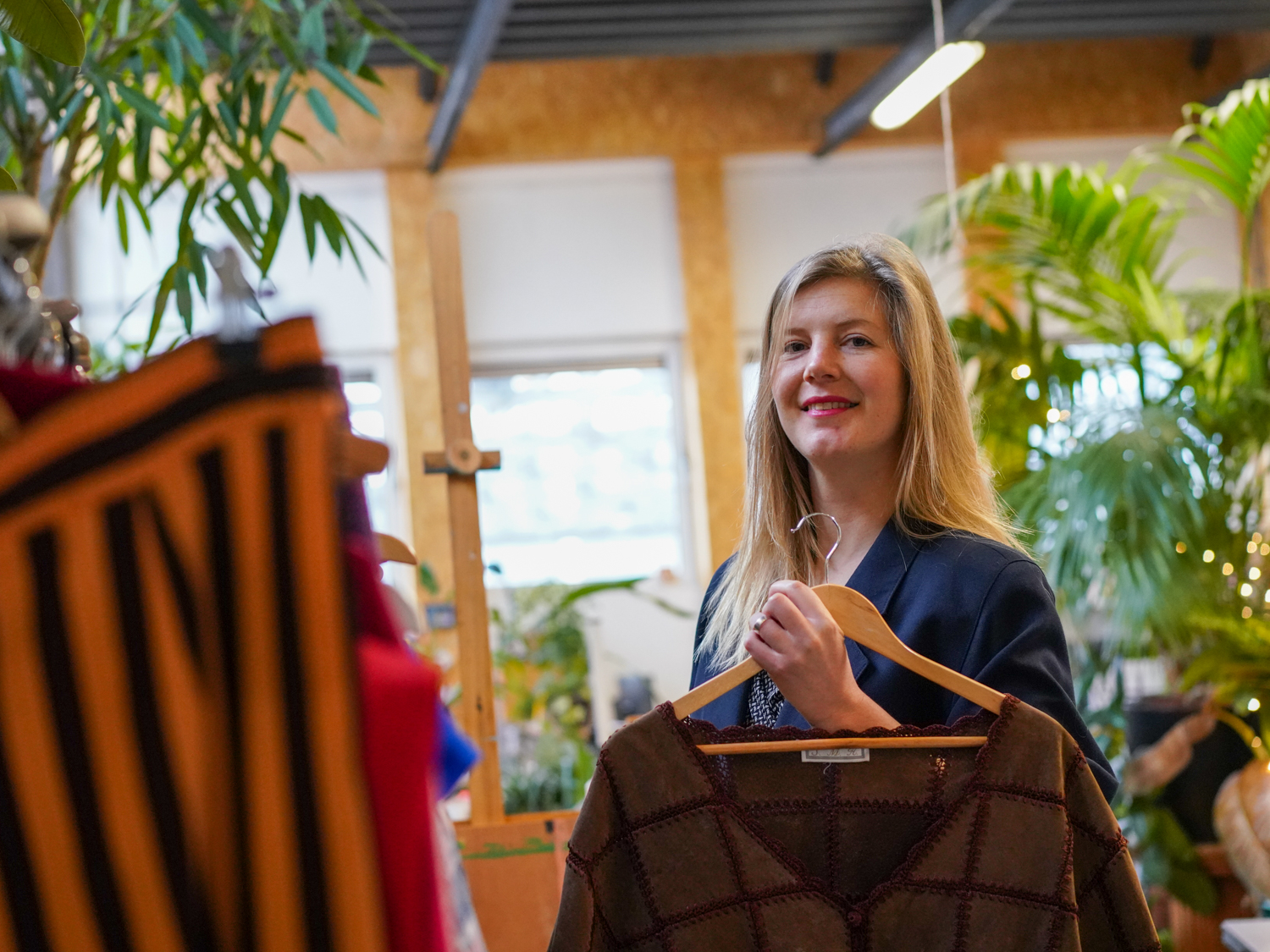
There’s a very specific feeling you get when you open your wardrobe and realize that most of it feels… finished. Not worn out. Just emotionally complete. The clothes have done their job. They’ve witnessed versions of you that no longer clock in every morning. And yet they stay. Waiting. Taking up space. Holding memories you don’t actively need, but don’t quite know how to release.
We’re taught that the solution to this feeling is buying something new. A reset. A refresh. A small dopamine injection in the form of fabric. But what if the real relief doesn’t come from adding—but from circulating?
I’ve been thinking about that a lot lately. Probably because, right around the corner from where I live, there’s a place that quietly dismantles everything we’ve been taught about ownership, novelty, and value. It doesn’t call itself a shop. It doesn’t use price tags. And nothing there is “for sale.”
It’s called a clothing asylum.
The Radical Softness of the Word “Asylum”
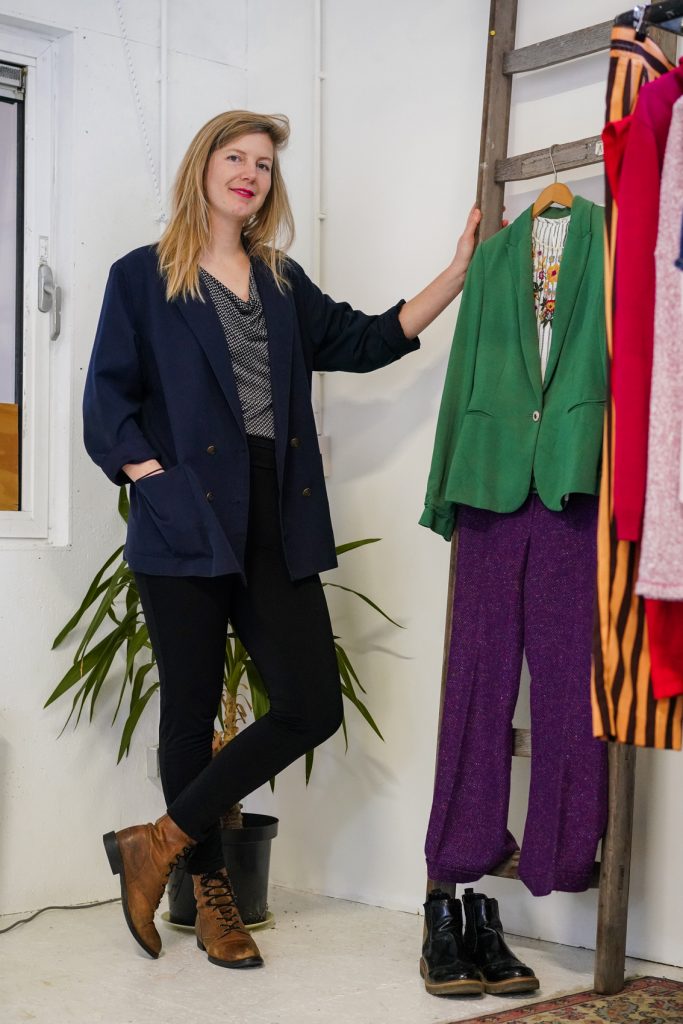
“Asylum” is an interesting choice. It suggests refuge. Safety. A pause from judgment. Historically, it’s a word loaded with complexity—sometimes care, sometimes confinement, always power. But in Astrid Meijs’ hands, it becomes something gentler. Almost tender.
Her Clothing Asylum lives inside De Vrijhaven Utrecht, a creative work hub that already feels like a pocket universe slightly detached from commercial time. You don’t stumble in accidentally. You arrive intentionally.
The concept is deceptively simple: one-for-one swapping. You bring a garment you no longer wear. You take one home. That’s it. No money. No ranking system. No hierarchy between brands, decades, or perceived value.
And somehow, that simplicity is exactly what makes it radical.
Astrid, Before the Asylum
Astrid didn’t arrive here as a sustainability saint. She’ll tell you that herself, without hesitation. During her college years, she was what she calls a compulsive buyer. Clothes came in faster than they could be processed emotionally. The wardrobe grew. The disconnect grew with it.
What complicated this was her upbringing. Environmental awareness wasn’t an aesthetic in her family—it was practical, almost moral. Her father’s long-standing involvement in protecting nature created a quiet tension: how do you reconcile abundance with values rooted in care?
The first solution wasn’t ideological. It was social. She started giving clothes away to friends. Not as charity, but as circulation. And somewhere in that informal exchange, a question appeared that tends to change things permanently once asked:
Why are we all buying separately, when we could just… swap?
From Small Gestures to Collective Chaos
Swapping started small, as these things often do. A few friends. A few piles of clothes. A few moments of recognition when someone lights up wearing something that used to be yours.
But then it grew. Fast.
Astrid began organizing swap parties—real ones. Hundreds of people. Music. Beer. Dancing. Games. The kind of joyful chaos that feels more like a festival than an ethical exercise.
One of the last parties before Covid took place in an underground basement of a historic canal house. Tables around a dance floor. Handwritten signs marking categories. One bag in, one bag out. No exceptions.
The result? Absolute mayhem, in the best possible way.
People trying on clothes everywhere. Mirrors becoming optional. Spontaneous catwalks breaking out between sips of beer. The kind of environment where bodies are less scrutinized because everyone is too busy participating.
It wasn’t about curating a perfect outfit. It was about play.
And play, it turns out, is deeply subversive in a fashion system built on anxiety.
Then the World Closed Its Doors
Covid didn’t just cancel parties. It exposed how fragile our systems of togetherness really are. Suddenly, all the spaces built on physical closeness disappeared. Including swapping.
But the need didn’t go away. If anything, it intensified.
Selling clothes online—through platforms like Vinted—works for some people. But it requires a specific kind of labor: photographing, describing, negotiating, packaging, waiting. It turns letting go into a project. And not everyone wants that.
One night, Astrid woke up with a phrase looping in her head: Clothing Asylum.
The next day, she acted on it. An Instagram account. A call for donations and adoptions. A physical rack. A few rules. No grand opening. No marketing campaign. Just a place.
What Lives on the Rack
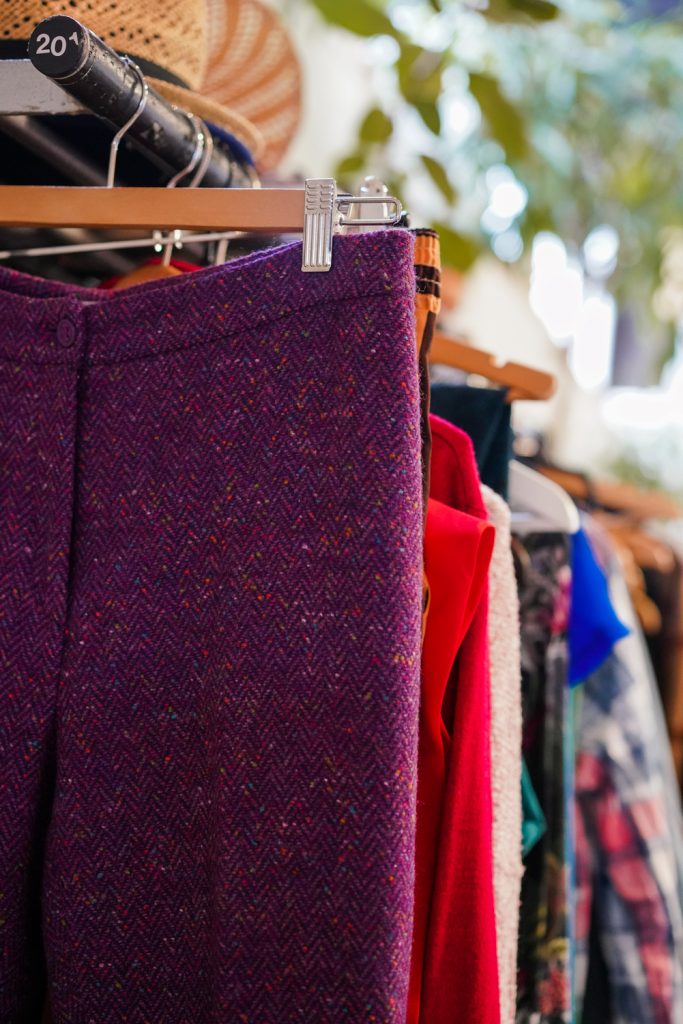
Three months in, the asylum was already full. Not overflowing—curated through care rather than control. Clothes, shoes, bags, hats. Pieces with personality. Pieces that feel chosen, not dumped.
Astrid set a few conditions. The clothes must be clean. Unstained. Unripped. This isn’t about passing on guilt or unloading responsibility. It’s about respect—for the next wearer, and for the garment itself.
And something interesting happened.
People rose to the occasion.
Almost everyone who donated tried to bring good pieces. Not trend leftovers. Not “maybe someone else will want this.” But items that still had life in them.
Which suggests something quietly hopeful: when you remove money from the equation, people often act better, not worse.
The Ritual of Appointment
You don’t just wander in. You make an appointment via Instagram. This small barrier does something important: it slows things down. It turns the visit into an event rather than an errand.
Some people pop in quickly. Others stay for hours. Trying on literally everything. Talking. Telling stories about clothes they’re leaving behind. Discovering versions of themselves they didn’t expect to meet that day.
It’s not retail time. It’s human time.
And that difference matters more than we tend to admit.
Why Swapping Feels Different Than Shopping
Shopping is transactional. Even when it’s fun, it’s linear: desire → purchase → ownership.
Swapping is circular. It forces you to acknowledge that what no longer serves you might be exactly what someone else has been looking for. That value isn’t fixed. That taste is temporary. That identity moves.
There’s also a subtle ego death involved.
You don’t get to “win” by spending more. You don’t get status points for brand recognition. A Zara blouse can sit next to a silk vintage dress without explanation. The garment has to speak for itself.
In a culture obsessed with signaling, this is quietly destabilizing.
The Politics of Access
What makes the Clothing Asylum especially compelling is its accessibility. No entrance fee. No minimum donation value. No assumption about taste, income, or body.
Sustainable fashion often struggles here. It can become aspirational, aestheticized, expensive. Swapping, when done like this, sidesteps that trap.
It doesn’t ask you to buy better.
It asks you to participate differently.
That distinction is everything.
Clothes as Social Objects Again
Historically, clothing was communal by default. Passed down. Altered. Borrowed. Shared. Only recently did we start treating garments as isolated, individual assets.
The asylum reactivates clothing as social objects. Items with pasts and futures. Pieces that carry energy—not in a mystical way, but in a relational one.
You don’t just take a jacket. You take a story. Even if you never hear it out loud.
Not a Utopia—A Practice
Is swapping a perfect solution? Of course not. It won’t dismantle global supply chains overnight. It won’t replace the need for systemic change.
But it does something arguably more important: it makes alternatives feel livable.
Not preachy.
Not punitive.
Not joyless.
It proves that sustainability doesn’t have to look like restraint. It can look like abundance—just shared differently.
Watching People Let Go
One of the most striking things about the Clothing Asylum isn’t what people take. It’s how they leave things behind.
Letting go is a skill. One we’re rarely taught.
Here, it happens gently. With witnesses. With context. With the quiet knowledge that the garment isn’t disappearing—it’s moving.
And that seems to make all the difference.
Why This Matters More Than It Looks
It’s easy to dismiss small initiatives as symbolic. But culture doesn’t shift through abstractions. It shifts through practices people can touch.
Astrid’s asylum isn’t loud. It doesn’t brand itself as revolutionary. It doesn’t optimize for growth.
It simply exists. And by existing, it creates a crack in the dominant story—one where newness is mandatory, ownership is sacred, and accumulation equals success.
Inside that crack, something else grows: trust. Play. Circulation.
Leaving With Lighter Hands
Every time I walk past De Vrijhaven, I think about how rare it is to encounter a space that doesn’t try to sell you a better version of yourself.
The Clothing Asylum doesn’t promise transformation. It doesn’t suggest that the right outfit will fix anything.
It just offers continuity.
A reminder that clothes don’t need to be hoarded to be loved. That value doesn’t need a price tag. That style can be collective without becoming uniform.
And maybe that’s the quiet magic of it all.
Not the swapping itself—but the permission it gives us to relate to clothing, and to each other, a little more lightly.