Searching for a wedding dress is a curious thing. It is both intensely personal and yet strangely public, like auditioning a piece of clothing to become the witness to one of the most intimate ceremonies of your life. I began my quest early, partly out of prudence, partly out of excitement, and partly because, let’s be honest, I had the pandemic’s strange, suspended time to wander endlessly through Instagram, vintage sites, and online boutiques.
The irony of planning a wedding during Covid-19 is palpable: your imagination is free, yet your mobility is restricted. Bridal stores are closed, large gatherings impossible, and the usual tactile joy of running your hands over lace or silk replaced by pixels on a screen. Still, necessity breeds invention, and necessity also breeds discovery. That’s how I found Marieke from Japon Vintage, whose boutique in the North of the Netherlands became my lifeline to a dream I feared I could not touch.
The first encounter was through a video call, an experience that I feared would feel sterile and transactional. Instead, it was warm, meticulous, and intimate. Marieke did more than show me dresses. She observed, suggested, and imagined. She quickly assessed which styles resonated with me and offered ideas on restyling, layering, and accessorizing in ways I hadn’t considered. By the end, the dress that would become my vintage dream felt almost like it had been waiting for me all along, and not just sitting in a boutique, waiting to be chosen.
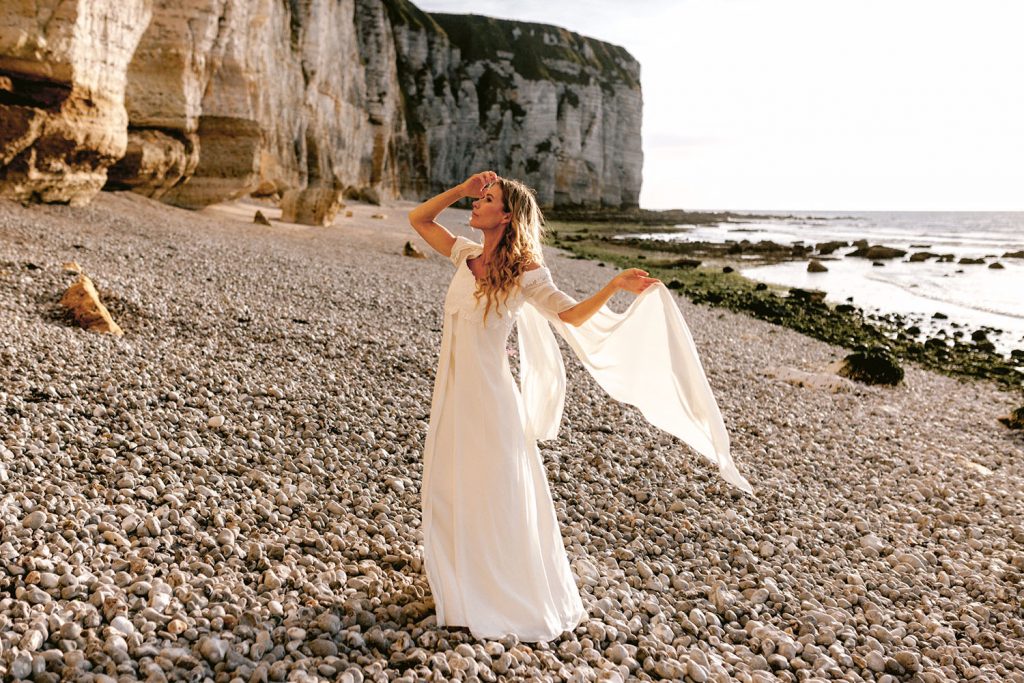
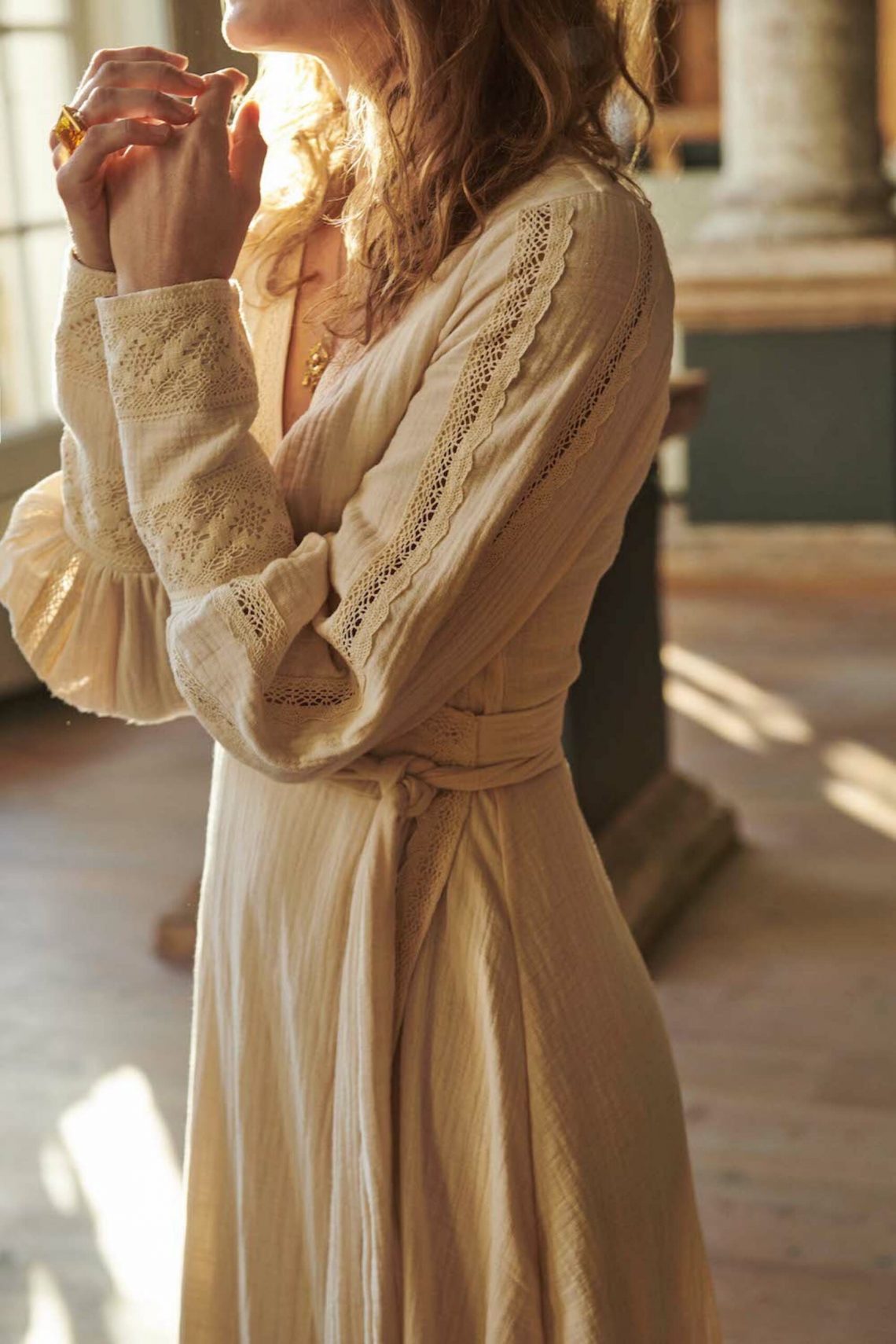
The allure of vintage, especially for a wedding, is layered. It is not simply about wearing an older garment; it is about wearing a story. Fabrics that have touched the hands of others, designs that echo the eras they were born in, details that speak of craftsmanship often lost to fast fashion—it all contributes to the sense that the dress itself has life. Vintage dresses, unlike their mass-produced counterparts, carry a narrative that you become part of the moment you put them on.
But finding such garments requires patience, discernment, and a bit of luck. Laura Dols Antieke Trouwjurken in Amsterdam, for instance, offers a treasure trove of possibilities. Here, the concept of affordability meets history: dresses average around 450 euros, and yet each one carries a story. The collection is not limited to gowns; it includes wedding shoes and accessories that complement the ethos of a wedding that is as sustainable as it is personal. The charm of this store lies not just in what is on the racks, but in the feeling that each item has already lived, survived, and now awaits a continuation of its story.
Then there’s Namanama, curated by Nathalie from Limburg, whose Instagram alone is an invitation into a world of handpicked, antique, and sustainably sourced dresses. The images capture light and texture in a way that transcends mere online shopping—they almost read like love letters to the garments themselves. Each gown is a dialogue between past and present, offering brides the chance to adorn themselves in pieces that have been chosen with both aesthetic and ethical intention.
Moonshine Vintage, curated by Lina, brings another layer to the search. Here, quality and narrative converge in 35mm film photographs that feel more like art than cataloging. Each garment tells a story not only through its fabric and design but also through the lens of a photographer who understands that sustainability and beauty are intertwined. When you explore such collections, you don’t just shop—you participate in a practice that honors material history and environmental consciousness simultaneously.
And then there is Lovely Lane, perhaps one of the most striking examples of contemporary sustainable bridal design. Here, the vintage inspiration is not about re-selling old garments, but about creating new ones imbued with historical reverence. Marije, the designer, traverses the globe to find vintage clothing and lace, drawing on this as a foundation for new creations. The garments are made slowly, carefully, and sustainably, on a pre-order basis in Amsterdam, combining ethical production with exquisite craftsmanship. Tailors from Syria, Iraq, and Russia work within the cooperative Made Here, producing pieces that are handmade and unique. Each dress is a conscious act: a statement against mass-produced impermanence, a commitment to beauty and sustainability that cannot be rushed.
The appeal of this approach is not simply ethical; it is profoundly human. There is an intimacy in knowing the hands that touched your dress, the thoughtful selection of every lace trim, the conscious choice of sustainable fabrics. In a world dominated by disposable fashion, such garments feel radical. They are made to last, to be worn, to age gracefully, and, in their own way, to witness your story without erasing the past or compromising the future.
During this journey, I realized that finding a wedding dress today is as much about values as it is about style. Sustainability is no longer a secondary consideration; it is central. And in a world where the fashion industry contributes heavily to environmental degradation, seeking a gown that honors both your body and the planet becomes an ethical statement. It is a way of saying: I can celebrate my life without compromising the lives of others, human and non-human alike.

The process of shopping sustainably—whether vintage or ethically produced new—requires patience and discernment. Online platforms, especially during a pandemic, are invaluable. Video consultations, detailed photographs, and attentive guidance from boutique owners allow brides to feel connected to the garments even when physically distant. Yet even in a digital format, the essence of sustainable bridal shopping is tactile, relational, and intimate. It is not only the dress you wear—it is the experience you carry forward.
One of the most illuminating lessons in this process was discovering that “sustainable” does not equate to compromise. It does not mean bland, limited, or aesthetically muted. Vintage collections brim with individuality, color, and imagination. Ethical brands like Lovely Lane transform recycled or sustainably sourced materials into works of art that rival conventional luxury. These garments respect the environment while delighting the senses. They prove that beauty, craft, and consciousness need not be mutually exclusive.
The psychological dimension is equally compelling. Choosing a vintage or sustainable dress alters the narrative of the wedding itself. Instead of a day framed by consumption and spectacle, it becomes a celebration of choices, history, and intentionality. Every stitch, every lace panel, every pattern becomes a symbol of awareness, a reflection of values, and a quiet manifesto of how we wish to live and love.
It is also worth noting that sustainable bridal shopping is often more inclusive and affordable than mainstream bridal couture. Vintage shops like Laura Dols offer pieces at moderate prices, making ethical choices accessible without sacrificing elegance or narrative richness. Meanwhile, slow fashion designers produce limited quantities, avoiding the environmental and social pitfalls of mass production. Brides are given options that are beautiful, meaningful, and responsible.
Yet there is a subtle artistry in combining these elements. A vintage dress may require gentle restoration, thoughtful accessorizing, and careful styling to fit the bride’s personal story. A newly designed sustainable gown may integrate antique lace or inspired detailing that bridges eras. The bride becomes a curator, assembling a narrative from garments that carry history, meaning, and intention. In essence, she participates in a temporal dialogue, connecting past, present, and future in the fabric she wears.
The pandemic underscored a truth I had long suspected: shopping can be transformative not only in the sense of acquiring, but in the sense of discovery. Seeking a sustainable wedding dress requires curiosity, patience, and imagination. It demands that we reconsider what we value in clothing, and how those values intersect with our most personal moments.
For anyone navigating this journey, a few practical tips emerge. Start early: the best vintage and ethical options often require lead time. Engage with boutique owners personally—video calls can become surprisingly intimate consultations. Research materials, provenance, and craftsmanship, and embrace garments with stories to tell. Most importantly, allow yourself the freedom to reinterpret your vision: a dress that was once imagined for a summer ceremony can transform beautifully for spring, winter, or a garden setting. Flexibility and imagination are key.
At the end of this search, the act of wearing the dress becomes layered with meaning. You are not merely donning fabric; you are entering into a pact with history, sustainability, and beauty. Your choices ripple outward—supporting artisans, small businesses, and ecological consciousness. A wedding gown thus becomes a narrative device, a testament to the idea that celebration need not conflict with conscience.
In truth, finding a sustainable wedding dress is about more than shopping. It is about approaching your wedding, and by extension your life, with mindfulness. It is about choosing carefully, respecting history, honoring craft, and celebrating creativity that does not exploit the planet. And when you finally step into a gown that carries both story and intention, it feels unlike any dress you have worn before. It feels like possibility. It feels like legacy.
Through Japon Vintage, Laura Dols, Namanama, Moonshine Vintage, and Lovely Lane, brides today can navigate a world of options that honor their ethics and aesthetics. Each offers a gateway into a practice of celebration that is thoughtful, beautiful, and sustainable. In seeking these dresses, we learn that style need not be separated from consciousness, and that love—both for oneself and the world—can be worn literally, on the day we choose to declare it.
Your wedding dress does not have to be a disposable spectacle. It can be a story you inherit, preserve, and extend. It can be a conversation across generations, between cultures, and with the planet itself. And when you wear it, you are not only seen—you are participating in something larger than the day, the ceremony, or the fashion. You are participating in the future you wish to live.
Sustainable wedding dresses, whether vintage or ethically made, teach patience, reflection, and imagination. They invite us to slow down, to consider our desires, and to honor the world from which these garments emerge. The search is, in its way, a meditation. It is a practice of seeing not just the dress, but the interconnected threads of culture, craft, and conscience.
And when at last you find it—your dress that is beautiful, meaningful, and responsible—you step into it not just as a bride, but as a participant in a larger narrative: a story that encompasses history, artistry, sustainability, and intention, all woven into fabric that will carry you forward into a new chapter of life.
This is where we discover that the perfect dress is more than an aesthetic triumph. It is an act of mindful love. It is a testament to the possibility that beauty, ethics, and joy can coexist. And it is proof that even in times of restriction and uncertainty, the pursuit of something meaningful is always worth the journey.
It is here, in vintage boutiques and carefully curated sustainable ateliers, that a bride can find not just a wedding dress, but a story she will carry forever—a story sewn with intention, draped in history, and designed to honor both the day and the world we inhabit.