I’ve never understood the slogan that diamonds are a girl’s best friend.
They’ve always felt a little too loud to me. Too declarative. Too certain of their own value.
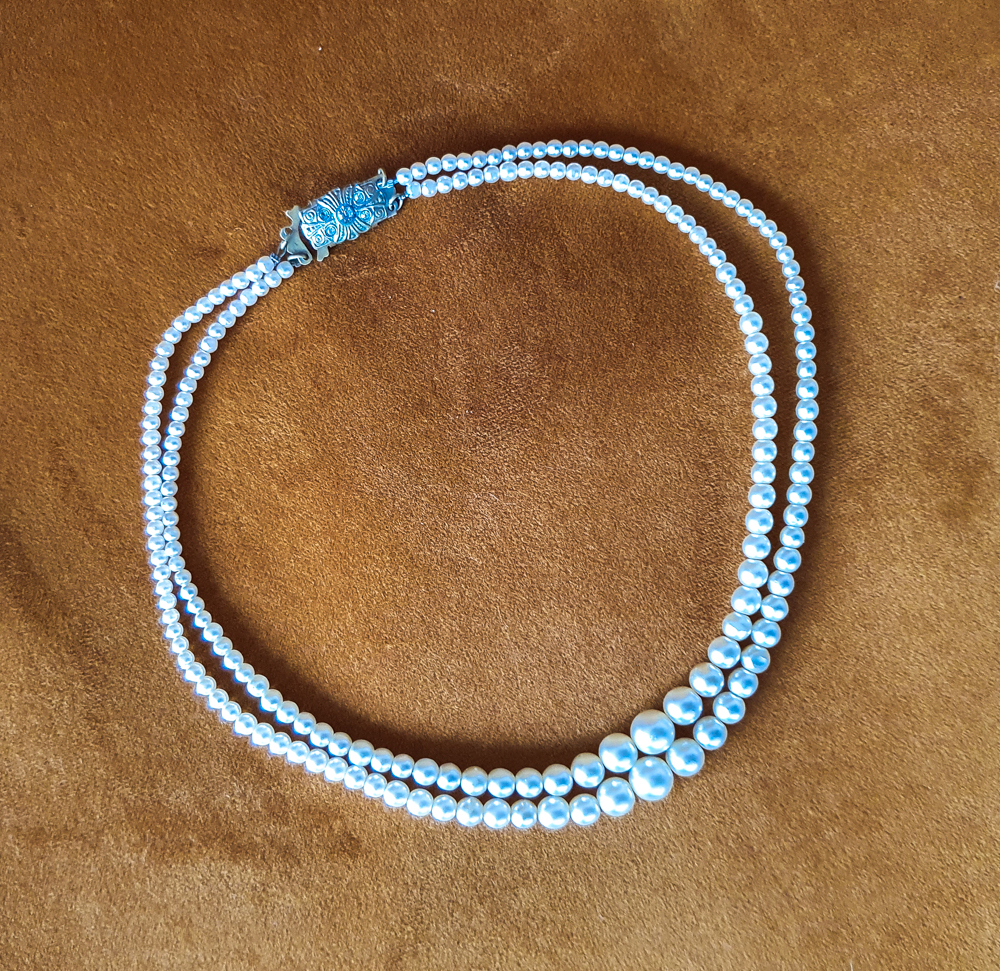
What makes my heart tick faster is something subtler: a ring that carries the quiet geometry of the 1920s. A slightly worn clasp that suggests decades of careful fastening. A pearl necklace that has outlived at least three wardrobes and possibly one great love. I’m not seduced by sparkle alone — I’m seduced by memory.
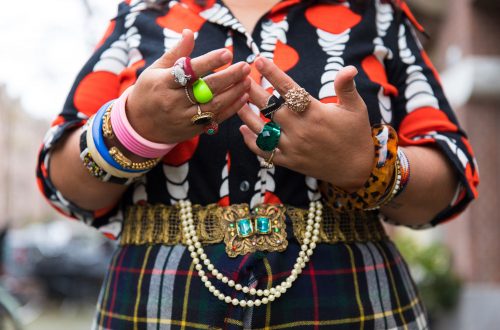
And yet, when friends tell me they’re “looking for new jewelry,” their instinct is rarely to look backward. They’ll wander into a high street store, hover near the checkout, and pick up a pair of gold-toned hoops produced somewhere far away under conditions we’d rather not examine too closely. I’ve done it too. Impulse glitter. Disposable adornment.
But jewelry, historically, was never meant to be disposable.
Long before mass production democratized accessories, jewelry functioned as archive. It carried lineage, status, devotion, sometimes even survival. Gold coins stitched into garments. Lockets holding portraits. Signet rings sealing correspondence. Ornament was narrative.
So when I started paying closer attention to what I wear — not only clothes, but the smaller details — it felt almost contradictory to pair a consciously sourced outfit with earrings that came wrapped in plastic.
That’s when I fell down the vintage jewelry rabbit hole.
And, somewhat unexpectedly, that rabbit hole led me to Instagram.
Yes, the same platform that fuels fast trends and algorithmic desire has also become a quiet marketplace for the past. A place where antique signet rings and 1980s plastic statement earrings coexist in a kind of curated digital flea market. It’s chaotic, occasionally overwhelming, sometimes dangerously tempting — but if you know how to look, it can also be deeply rewarding.
Before we dive into specific shops, let’s address the ethical undercurrent.
Mining precious metals and stones is not benign. As resources become scarcer, extraction goes deeper. That depth comes with risk — environmental collapse, toxic chemical exposure, mercury contamination, deforestation, displacement of communities. Gold, especially, has a complicated and often violent history. The shimmer hides a cost.
Vintage and preloved jewelry bypasses the need for new extraction. The gold already exists. The gemstone has already been mined. No additional landscape needs to be disrupted for you to wear that ring. The environmental footprint is significantly lower, not because it is impact-free, but because it is impact-already-paid.
There is something profoundly satisfying about that.
But beyond ethics, there is aesthetic freedom. Trends repeat — as Pete Philly once sang, history repeats — and jewelry cycles through decades like a restless archivist. Chunky 80s hoops. Delicate Edwardian filigree. Bold 70s signets. Minimal 90s silver. It’s all resurfacing, reframed.
Instagram has accelerated this repetition. A vintage shop can post a 1960s chain one day and watch it sell within minutes to someone thousands of kilometers away. It’s both intimate and global. The past, filtered and photographed, becomes scrollable.
Of course, the platform’s accessibility is both its charm and its danger. Not every account selling “vintage” is credible. And when money is transferred through direct messages and bank details, discernment becomes essential.
Over time, I’ve learned to look for certain signs.
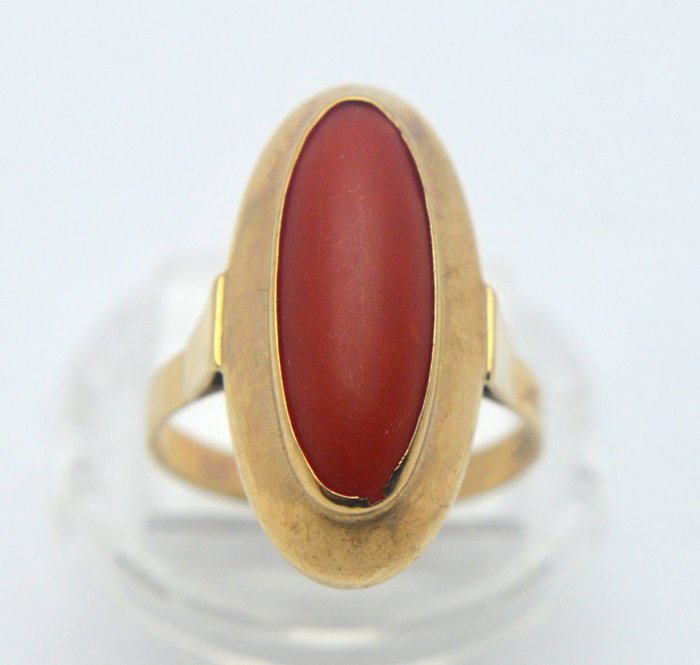
Real vintage jewelry shops usually have a specialty. Maybe they focus on antique gold rings. Maybe they curate 90s designer pieces. Maybe they specialize in colorful Bakelite earrings. When an account sells everything from “rare Victorian brooches” to brand-new fast fashion chains, something feels off. Expertise reveals itself in consistency.
Interaction matters too. Do followers comment? Does the shop respond thoughtfully? Are there tagged photos of real people wearing the pieces? Testimonials? Transparency about sourcing? Vague captions and stock-like photos are red flags.
And then there is geography. Where is the seller based? Shipping costs, import taxes, and customs fees can quickly transform a romantic purchase into a logistical headache. I once almost bought a delicate gold chain from the United States before realizing that the additional costs would rival the price of the piece itself. Romance cooled by bureaucracy.
Still, when the right piece appears, reason wavers.
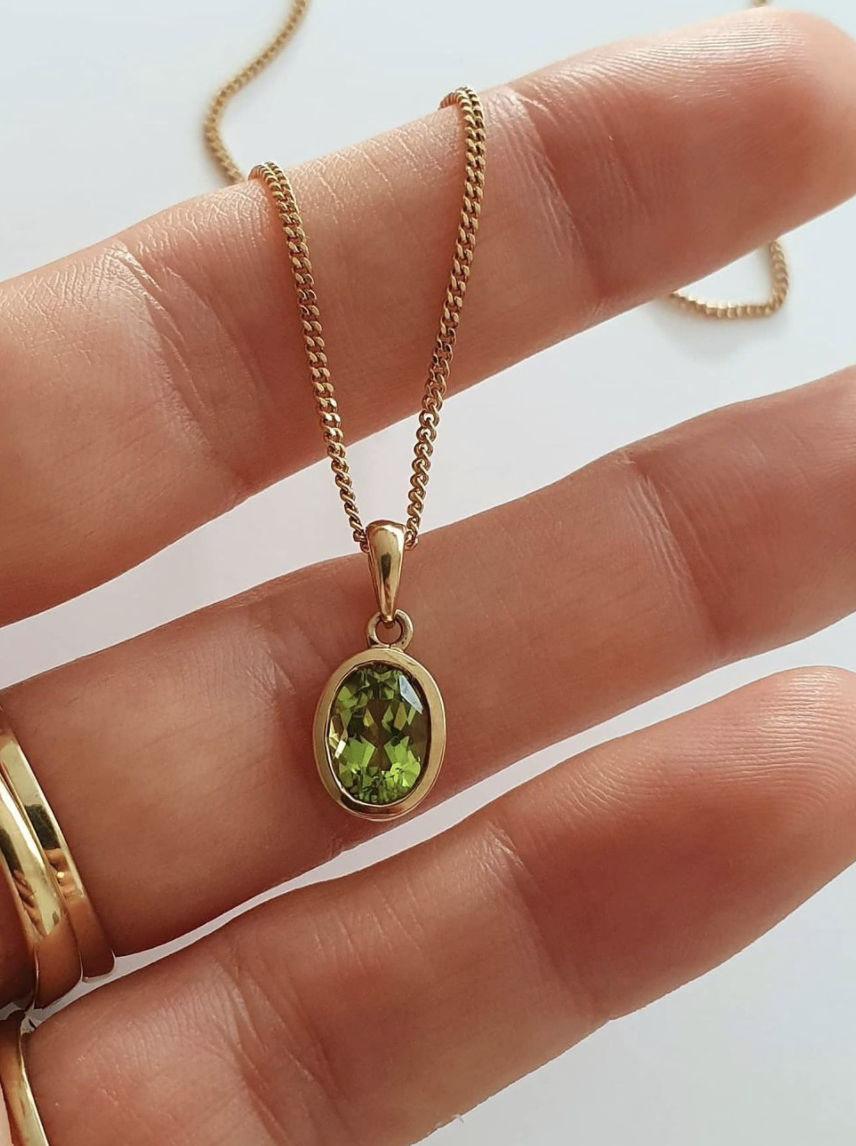
I recently bought a small peridot necklace from an Instagram shop called Pure Shores. It was one of those moments when you see something and feel an immediate click — not because it is flashy, but because it feels aligned. The stone was a soft green, not loud, not performative. The gold slightly worn in a way that made it human.
Is it an “investment piece”? I don’t know. I’m wary of framing every jewelry purchase as financial strategy. But I do know that I’ve worn it almost daily since it arrived. That counts for something.
Another account I quietly admire is The Gold Club. The name evokes something elitist — leather chairs, exclusive membership — yet the actual curation feels democratic in its enthusiasm. Rows of vintage rings, each with its own personality. Some chunky and bold, others slim and refined. It’s the kind of page that makes you imagine the hands these rings once adorned.
And then there’s Ruby Rose Jewellery, which leans into romantic silhouettes — delicate chains, ornate pendants, pieces that feel like they belong to handwritten letters and silk blouses. I don’t buy often. But I watch. I learn. I observe how quickly certain eras resurface.
There are countless others. That’s both the beauty and the danger. A simple hashtag search — #vintagejewelleryforsale, #vintagenecklace, #antiquering — opens a floodgate. Suddenly your algorithm shifts. You are no longer being fed fast fashion ads but curated relics. Your digital world becomes slightly more textured.
But here is where I pause.
Buying vintage is not automatically virtuous if it becomes another form of accumulation. Sustainability is not solved by replacing new excess with old excess. The temptation to hoard unique finds can be just as strong as the temptation to chase trends.
So I ask myself: do I love this piece, or do I love the idea of having found it?
There is a difference.
Vintage jewelry carries story, but that story is not always visible. Sometimes it is imagined. And imagination can romanticize. A ring might have belonged to someone who wore it daily with devotion — or it might have sat unworn in a drawer for decades. We project narratives because we crave continuity.
Perhaps that projection is part of the appeal. In a hyper-digital world, we long for objects that feel anchored in time. Jewelry that predates our scrolling habits. Jewelry that has survived trends before and will likely survive ours.
Culturally, we are also renegotiating value. Fast fashion taught us that accessories are disposable punctuation. Vintage reframes them as sentences — complete thoughts, capable of standing alone.
When you invest in a well-crafted vintage ring, you are not only buying metal and stone. You are buying durability. Craftsmanship from an era when pieces were often made to last decades, not seasons. Even the weight feels different sometimes. Solid. Intentional.
That said, vintage shopping on Instagram requires patience. Pieces sell quickly. Measurements are crucial. Ask for ring sizes in millimeters, not just vague descriptors. Request additional photos. Don’t be afraid to ask questions about hallmarks, materials, or condition.
A reputable seller will answer transparently.
And perhaps most importantly: sit with your desire for a moment before acting. Screenshot the piece. Close the app. Return a few hours later. Does it still call to you? Or was it the adrenaline of scarcity — “only one available!” — that triggered your impulse?
We like to think we are rational consumers. Instagram knows otherwise.
When I look at my small but growing collection of vintage jewelry, I see more than adornment. I see pauses. Considered decisions. Pieces chosen slowly, often after days of deliberation. They don’t match perfectly. They aren’t coordinated into a capsule. But they feel cohesive because they feel like me.
And that, perhaps, is the quiet revolution of vintage.
It resists uniformity. It resists speed. It resists the idea that beauty must be new to be valuable.
So if you’re looking to expand your jewelry collection, maybe begin not at the mall but in the endless scroll — with discernment, with curiosity, with restraint. Follow shops that specialize. Engage thoughtfully. Learn about eras, materials, hallmarks. Let your taste evolve.
Because somewhere between the algorithm and the archive, between glitter and memory, you might find a piece that feels less like an accessory and more like a continuation.
And that kind of sparkle doesn’t fade easily.