There is a very specific kind of heartbreak reserved for worn-out clothes.
Not the dramatic kind. Not the “I spilled red wine on silk” catastrophe. I mean the slow erosion kind. The thinning at the elbows. The collar that has softened beyond dignity. The small hole near the hem that you pretend not to see for three laundry cycles too long.
I fall in love with fabric first.
With a pattern. With a shade of blue that feels like late summer. With a cotton so soft it almost feels like memory. And when the garment itself reaches the end of its useful life, I find it irrationally difficult to let go.
We talk a lot about sustainable fashion in terms of buying better. Organic cotton. Recycled polyester. Ethical production.
But sustainability is also about endings.
What do you do when a piece is too worn to wear but too beloved to discard?
For me, the answer lately has been small and circular.
Scrunchies.
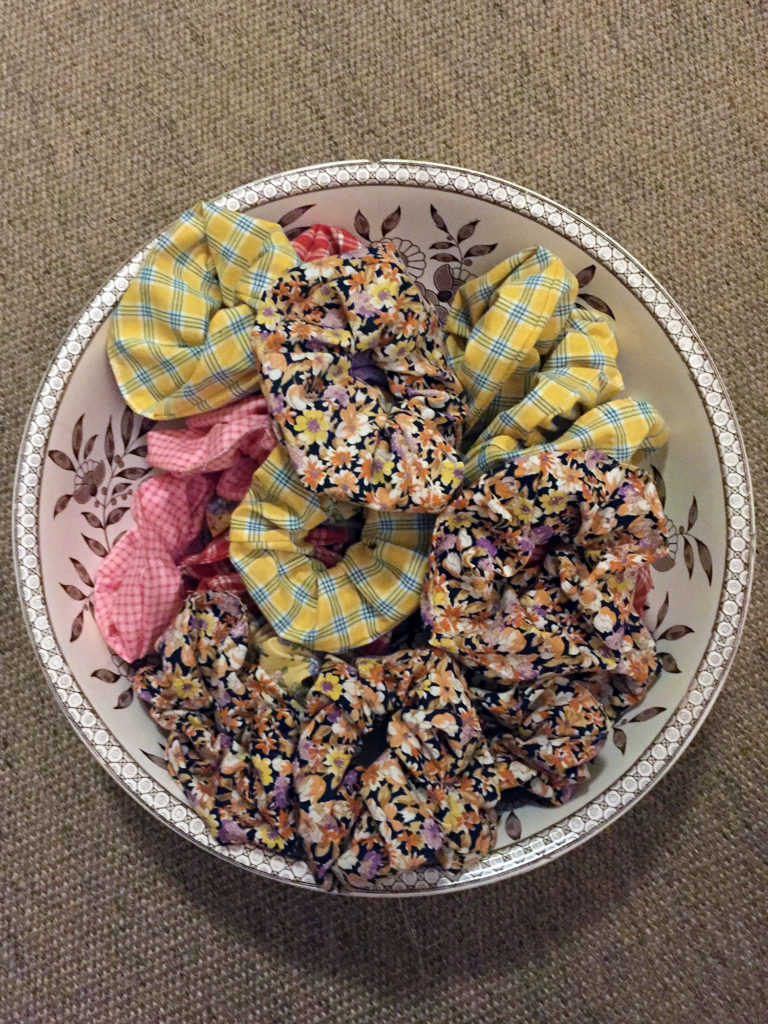
The Fabric Was the Point All Along
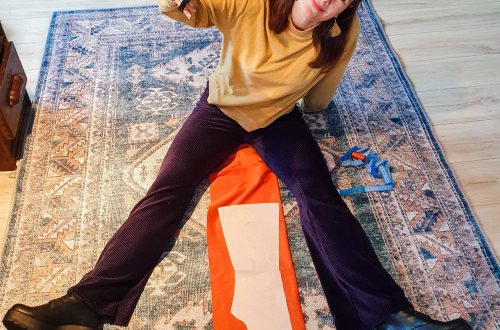
I started making scrunchies with my friend Milou, who approaches sewing the way some people approach meditation — calmly, precisely, without drama. She has that quiet confidence that comes from understanding how things are constructed.
We spread old garments across the table like archaeological findings.
A faded men’s shirt with a beautiful stripe. A vintage patch with colors that felt distinctly 1970s. A cotton blouse that had seen better days but still held a floral pattern I couldn’t part with.
When you cut into worn-out clothing, something interesting happens. The garment loses its narrative — the way it used to fit your body, the occasions it attended — and becomes pure material again.
Fabric.
Thread.
Texture.
In pre-industrial societies, this transformation would not have felt radical. Clothing was routinely repurposed. Dresses became aprons. Shirts became cleaning cloths. Quilts were stitched from remnants of lives lived.
We, on the other hand, have grown accustomed to linearity. Buy. Wear. Discard.
Turning worn-out clothes into scrunchies is almost laughably modest in comparison to historic reuse practices. And yet it feels quietly defiant.
Because it interrupts that line.
Why a Scrunchie?
You might ask: why not something more ambitious? A patchwork bag. A reconstructed top. A full-scale redesign?
The honest answer is that scrunchies are accessible.
They require small pieces of fabric. Even fragments too tiny for larger projects can be transformed. You can make two from a vintage patch and suddenly you’re holding something unique — something that carries history in miniature.
And there’s something charmingly nostalgic about them.
The scrunchie, emblem of the late ‘80s and early ‘90s, was once dismissed as juvenile. Then, as fashion cycles inevitably do, it returned. But this time not as a mass-produced afterthought — rather as a symbol of softness. Playfulness. A rejection of rigid minimalism.
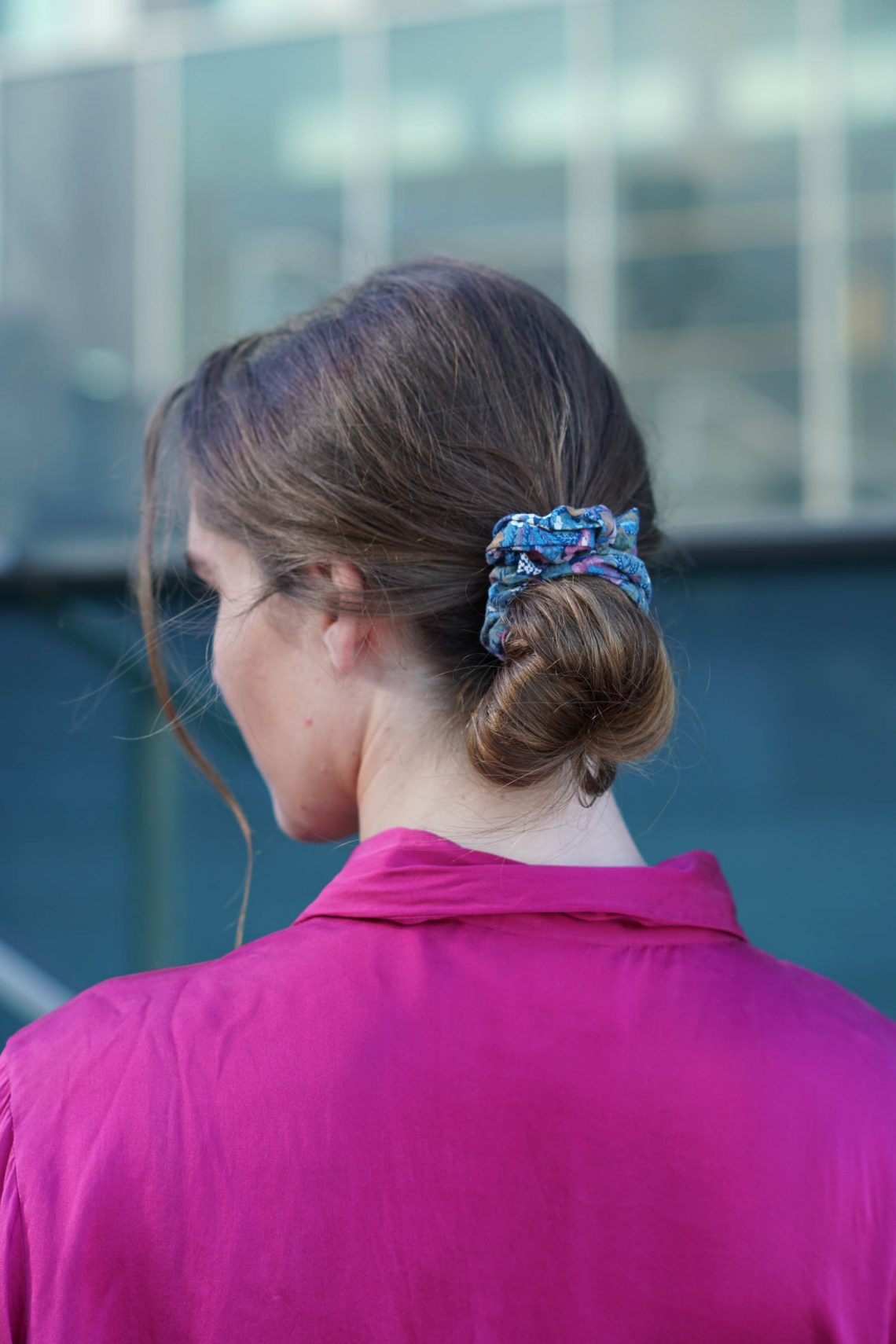
Wearing a scrunchie made from a former shirt sleeve feels different from wearing one bought in a plastic pack of five.
It carries a story.
The Beauty of Imperfect Materials
We found some vintage patches online — the kind of fabrics that feel slightly sturdier than what you encounter in most contemporary stores. The weave tighter. The colors deeper. Perhaps that’s nostalgia speaking, but there is a tactile difference.
Because the pieces were small, we could only make a couple of scrunchies from each. That limitation felt like a gift.
Scarcity forces care.
When you know you only have enough fabric for two, you measure twice. You cut deliberately. You treat the material as finite.
There’s a cultural critique embedded here, if you look closely. Fast fashion thrives on abundance — infinite options at negligible cost. But abundance often dulls appreciation.
Small projects with limited fabric sharpen it again.
We also cut into old cotton shirts — the kind that had softened beautifully over years of wear. Even when the collar is frayed beyond salvation, the fabric between the seams is often perfectly intact.
It made me reconsider how much we discard simply because one part fails.
A tiny hole does not invalidate an entire garment.
The Practical Ritual
If you’re curious, the process itself is surprisingly straightforward.
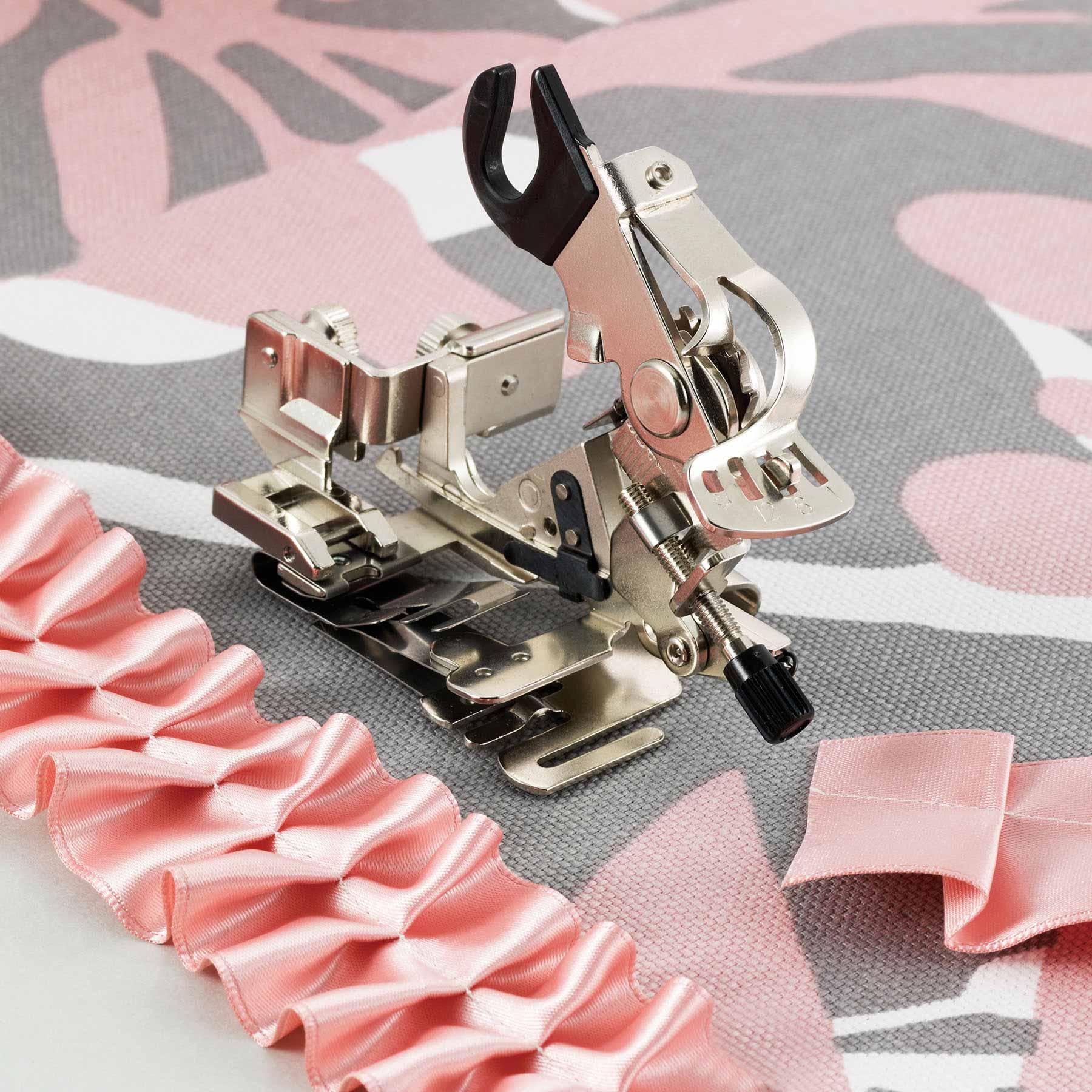
You need old fabric — obviously. An elastic band. Matching thread. Scissors. A sewing machine (though it can be done by hand if you’re patient). A large safety pin to guide the elastic through the tunnel. Tailor’s chalk, or honestly, just a pencil if you don’t want to be dramatic about it.
You cut a strip of fabric. Sew it into a tube. Turn it inside out. Thread the elastic through with the safety pin. Secure it. Close the seam.
That’s it.
The simplicity is part of the appeal.
In an era where so much of our consumption is abstract — one-click purchases, next-day deliveries — making something tangible from something old reconnects you to process.
You sit at a table. You measure. You stitch. You make mistakes. You unpick.
The rhythm of the machine becomes a kind of metronome.
There is something grounding about it.
Accessory as Memory Carrier
What surprised me most wasn’t the practicality of the scrunchies. It was how emotionally charged they felt.
I tied one made from an old striped shirt around my hair and immediately remembered the summer I wore that shirt constantly. The café where I first spilled coffee on it. The way the fabric softened after every wash.
The scrunchie became a small archive.
Fashion scholars often talk about clothing as a form of embodied memory. We store experiences in fabric. We attach identity to garments.
Upcycling allows those memories to persist in altered form.
Instead of a shirt hanging unworn in the back of a closet — or worse, decomposing in landfill — it becomes an accessory you reach for daily.
There is intimacy in that transformation.
Circularity on a Micro Scale
The fashion industry currently loves the word “circular.” Circular economy. Closed-loop production. Material regeneration.
These are important conversations. Necessary ones.
But circularity also exists at the scale of your kitchen table.
When you cut up a worn-out blouse and turn it into something new, you are practicing micro-circularity. You are extending the lifespan of material already in your possession. You are refusing to let it exit the system prematurely.
Of course, one scrunchie does not dismantle global textile waste.
But cultural shifts rarely begin at scale. They begin in small gestures that accumulate.
And there is something contagious about handmade things. When friends ask where you got that scrunchie and you answer, “It used to be a shirt,” the conversation shifts. Possibility expands.
Uniqueness Without Excess
We made several scrunchies in different colors and patterns. Some floral. Some striped. Some slightly chaotic.
Each one felt singular.
That’s another quiet pleasure of upcycling: the assurance that no one else will have the exact same piece. Not because you paid more. Not because it was limited-edition marketing. But because it emerged from something specific and personal.
In a world saturated with identical items, uniqueness has become commodified. But handmade uniqueness resists that logic.
It is slower. It is imperfect. It carries evidence of human hands.
Sometimes the stitching isn’t perfectly straight. Sometimes the fabric puckers slightly.
I find that reassuring.
A Different Relationship With “Worn-Out”
The phrase “worn-out” implies finality.
Finished. Exhausted. Done.
But what if worn-out simply means transitioning?
A shirt can be worn-out as a shirt but not as fabric.
When we change how we define usefulness, we change how we consume.
Instead of asking, “Is this still wearable?” we might ask, “Is there still material value here?”
That question reframes disposal as decision rather than reflex.
It also softens the guilt often associated with clothing waste. Instead of dwelling on past purchases, you engage in creative repair.
Not every garment can be salvaged. Not every fabric deserves resurrection.
But some do.
I still occasionally fall in love with a piece of clothing because of its pattern or texture. That hasn’t changed.
What has changed is my relationship with its eventual decline.
Now, when I notice thinning at the elbows or fraying at the hem, I don’t immediately think goodbye.
I think: what else could you become?
Sometimes, the answer is as small as a scrunchie.
And that is enough.