There is a particular kind of vulnerability in opening your closet to another person.
Not the curated version. Not the “I just reorganized by color and vibe” version. I mean the real one. The shelf with the impulsive sale purchases. The trousers that almost fit. The dress you loved in theory but somehow never wear. The sweater you keep for sentimental reasons even though it pills like it’s auditioning for a snowstorm.
A few months ago, I decided to stop buying clothes for a year.
I said it out loud before fully understanding what that sentence meant. It sounded reasonable in my head — even slightly practical. I own enough. I know that. We all know that. The fashion industry certainly knows that, though it prefers not to dwell on it.
But the reactions I received made me pause.
“Wow, that’s so brave.”
“I could never do that.”
“A whole year?”
You would think I had announced I was moving to a remote monastery.
It made me wonder: have we normalized shopping to such an extent that abstaining from it feels radical?
Still, the words were spoken. The commitment public. And if there’s one thing I’ve learned about myself, it’s that public promises have gravity. They tether you.
The first strategy for surviving a year without new clothes was obvious: I needed to see what I already had.
Not in a cursory, distracted way. In a deliberate, slightly uncomfortable way.
So I invited a friend.
Not just any friend. The kind of woman who has that effortless, almost unfair sense of style. The type who can throw on a shirt and somehow make it look intentional rather than accidental. Let’s call her Sanne.
The plan was simple: she would shop in my closet. Pull outfits. Recombine pieces. See things I no longer saw.
What I didn’t anticipate was the mild panic that set in thirty minutes before she arrived.
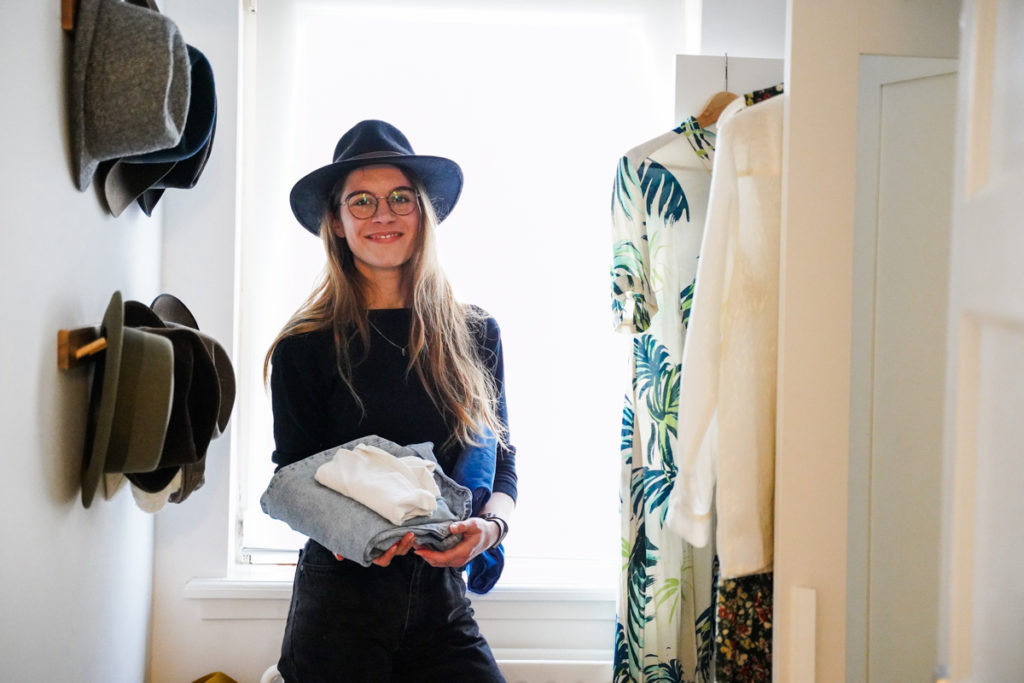
The Closet as Psychological Archive
It’s ridiculous, really. It’s just fabric. Cotton, wool, viscose. Buttons and zippers.
And yet, standing in front of my open wardrobe, I felt exposed.
What if she notices how many times I almost got it right but not quite? What if she silently judges that plaid suit I acquired at a clothing swap because I thought I should be “that kind of person”? What if she sees the gap between how I imagine myself and how I actually dress?
I suddenly understood something about closets: they are not storage spaces. They are psychological archives.
Every piece tells a story. A wedding attended. A phase embraced. A trend flirted with. An identity tried on and sometimes abandoned.
In sociological terms, clothing functions as both self-expression and social negotiation. We dress not only for ourselves but in conversation with our environments — workplaces, friendships, cities. Over time, wardrobes become layered maps of who we were trying to be.
Opening that map to someone else feels intimate.
So yes, I panic-cleaned. In twenty minutes, I reorganized everything. Hung things properly. Folded with an urgency that bordered on athletic.
Humans are extraordinary under perceived threat.
When Sanne arrived, she confessed her own anxiety. What if she couldn’t assemble outfits that felt like me? What if she imposed her aesthetic too forcefully?
It was oddly comforting. Even the stylish feel uncertain when stepping into someone else’s narrative.
Seeing Yourself Through Another Lens
There is something profoundly destabilizing — and liberating — about allowing someone else to interpret you.
We tend to see our wardrobes through a fixed script.
This is my “safe” outfit.
This is too bold.
This doesn’t suit me.
This is complicated.
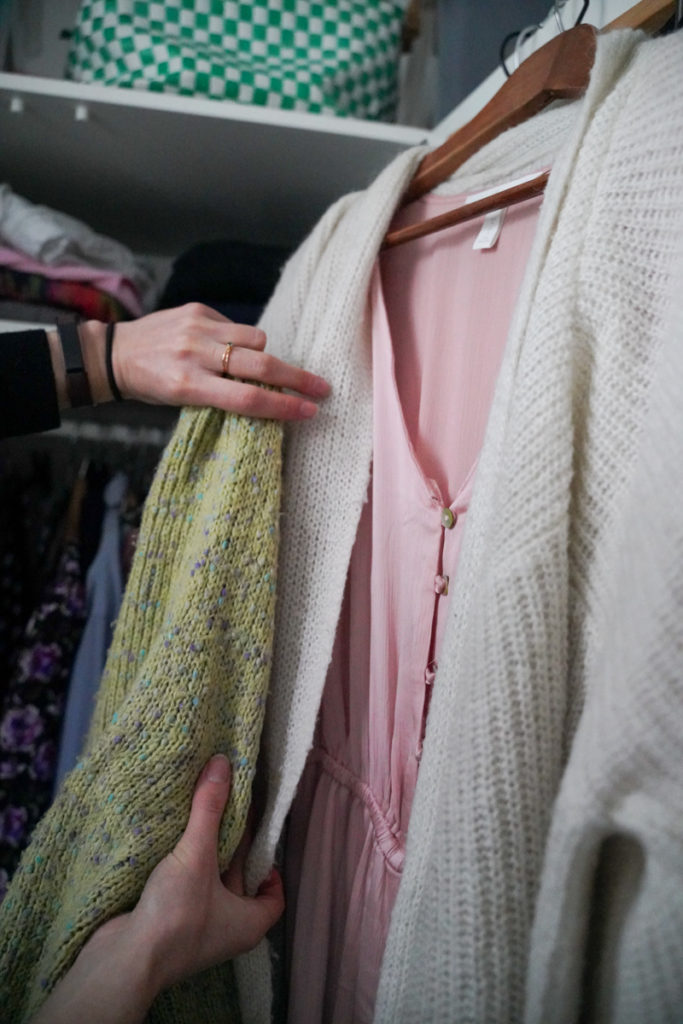
Sanne ignored the script entirely.
She pulled out the plaid suit first. The one I have a complicated relationship with. Slightly oversized. Slightly theatrical. The kind of garment that feels more confident on the hanger than on my body.
Instead of pairing it the way I had always imagined — with something equally tailored and serious — she layered a hoodie underneath. Sneakers. Suddenly the formality dissolved. The proportions shifted. It felt almost playful. A little Pharrell-meets-Barney, if that makes any sense.
I would never have done that.
Not because it’s technically difficult. But because I had mentally categorized the suit as “grown-up, structured, intimidating.”
She treated it as raw material.
That’s the first thing that happens when someone with style shops your closet: they dismantle your categories.
Color as Courage
One of the outfits she assembled was pure color.
I love vibrant tones in theory. I admire them on others. But I often retreat into neutrals when dressing myself. There is safety in black, in beige, in predictable harmony.
Sanne paired two strong colors I would never have combined — not because they clash aggressively, but because they demand attention. The result was energetic without being chaotic. Balanced in a way that felt accidental but wasn’t.
Color-blocking, at its core, is about confidence in contrast. It refuses subtlety. It acknowledges that visibility can be deliberate.
Historically, color has always carried social meaning — from aristocratic purples to revolutionary reds. Choosing bold hues is never entirely apolitical. It signals mood, sometimes defiance, sometimes joy.
Wearing that combination, I felt slightly outside my comfort zone — but also more alive.
Which made me question how often I dull myself without noticing.
Letting Fabric Move
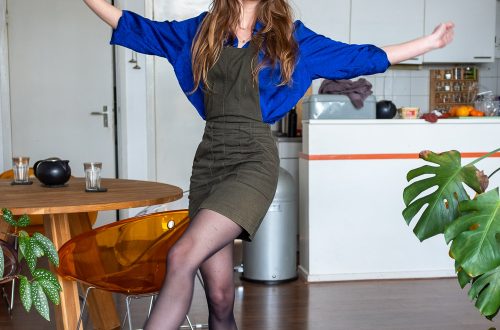
Another outfit was deceptively simple: a flowing skirt paired with a lightweight knit, layered in a way that emphasized movement.
“Let it flow,” she said, almost absentmindedly.
It struck me how rarely I prioritize movement when getting dressed. I think about fit. About proportion. About appropriateness. But not about how fabric behaves in motion.
There is a reason certain garments historically symbolized freedom — loose silhouettes, billowing sleeves, wide trousers. Movement suggests autonomy.
As I walked around my living room in that outfit, the skirt catching air slightly, I felt lighter. Less constrained by my own self-critique.
Sometimes style isn’t about sharp lines or clever tricks. It’s about permission.
The Social Experiment Beneath the Styling
On the surface, this was a harmless afternoon of dress-up.
Underneath, it was something else.
In an era of hyper-individualism, we guard our aesthetic identities carefully. “This is my style.” “This is so me.” We curate Instagram feeds, Pinterest boards, digital avatars.
But personal style doesn’t exist in isolation. It is shaped in dialogue — with friends, with cities, with cultural references.
Inviting someone into your closet is an acknowledgment that you don’t see yourself fully. That your self-perception has blind spots.
There is humility in that.
Fashion historians often discuss how trends emerge collectively rather than individually. Subcultures form when groups reinterpret clothing codes together. Style, at its most interesting, is collaborative.
This tiny experiment mirrored that dynamic on a personal scale.
After two hours, I felt like I had a new wardrobe. Nothing had been added. Nothing removed. The inventory was identical.
But the narrative had shifted.
The No-Buy Year, Reframed
When I first announced my no-shopping year, I framed it as abstinence. As discipline. As a test of willpower.
What I didn’t anticipate was that it would become an exercise in imagination.
We are conditioned to believe that novelty requires purchase. That reinvention requires transaction.
Letting someone with style shop my closet proved otherwise.
It also revealed something slightly uncomfortable: how quickly we tire of our own creativity. We exhaust the obvious combinations and assume the garment is the problem.
Often, it’s not.
It’s our limited vantage point.
The Difference Between How We See Ourselves and How Others Do
There’s a psychological concept called the “spotlight effect” — the tendency to believe others notice us more than they actually do. In fashion, we invert it. We assume others see our flaws as clearly as we do.
But when Sanne styled me, she didn’t focus on my perceived shortcomings. She saw potential. She saw coherence where I saw chaos.
That shift is powerful.
It makes you wonder how much of your self-image is self-imposed limitation.
Maybe you are bolder than you think. Maybe you can carry that oversized blazer. Maybe you can mix those colors. Maybe the dress you abandoned isn’t wrong — it just needs a different partner.
Style, at its best, is not about perfection. It’s about exploration.
When Sanne left, the apartment looked the same. The wardrobe doors closed as usual. The hangers aligned obediently.
But something had changed.
I no longer saw my clothes as static objects awaiting replacement. I saw them as pieces in an unfinished conversation.
If you want a fresh look at your wardrobe, yes — you can reorganize it. You can declutter. You can photograph combinations in advance.
Or you can do something slightly braver.
Hand the key to someone whose eye you trust. Let them misinterpret you a little. Let them surprise you.
You might discover that you don’t need to shop at all.
You just need to see yourself — and your closet — through a different lens.