I knew it was a questionable decision the moment I clicked “buy.”
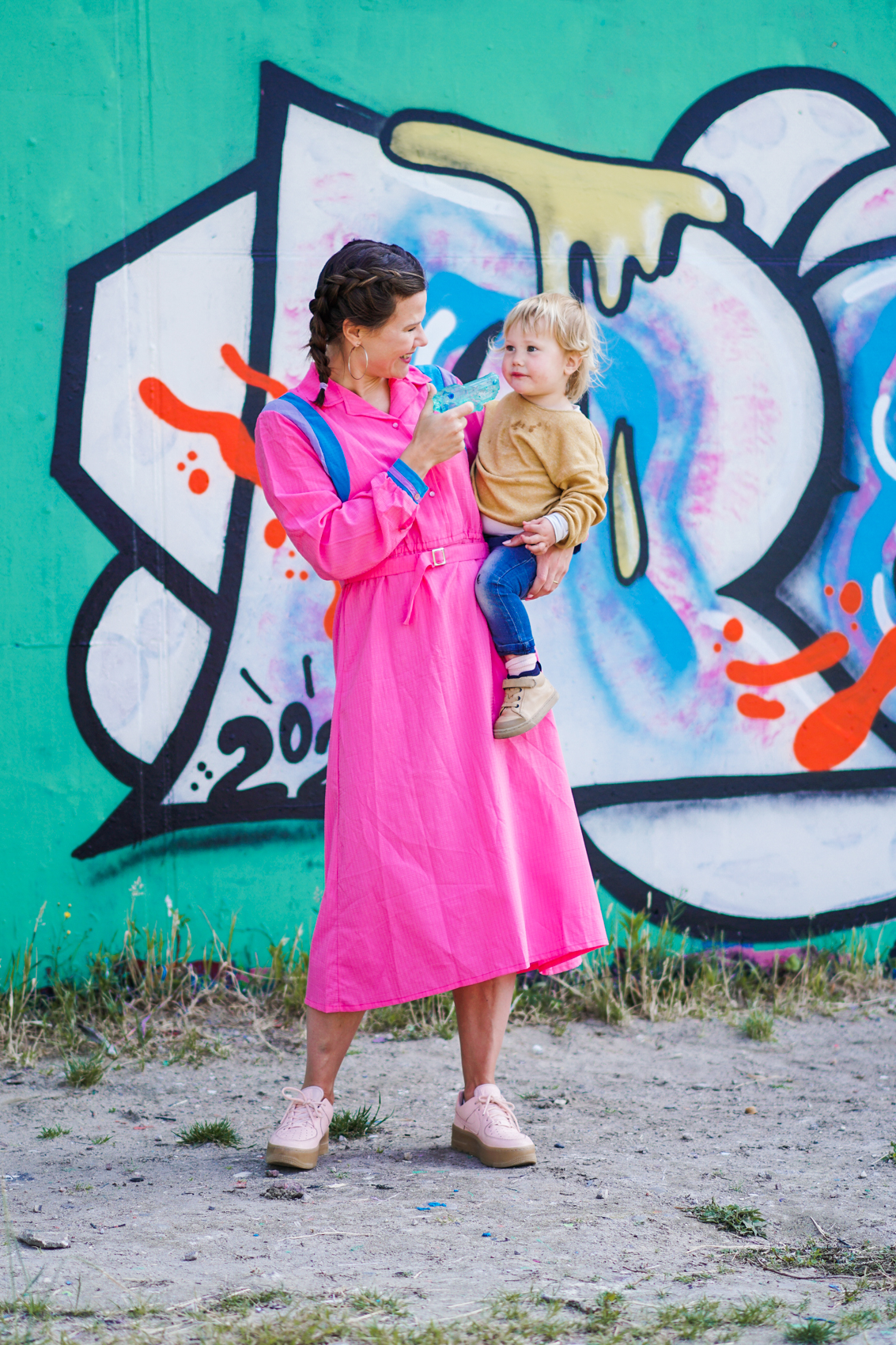
Last summer, somewhere between midnight scrolling and a vague promise to myself that I would only search for “practical basics,” I found it on Vinted. A dress so unapologetically pink it looked like it had escaped from an eighties aerobics video and a retro housewife sitcom at the same time.
It was structured and dramatic. Sporty and sweet. A tracksuit that had decided to become a lady.
Love at first sight.
And then it arrived.
I took it out of the parcel, held it up against the light, and felt that small, sinking realization: this dress does not need me. It is an outfit. A statement. A performance. What exactly am I supposed to add to something that already shouts?
That question stayed with me longer than I expected.
Because if I’m honest, I don’t usually think in formulas when I get dressed. I cook the same way: I open the fridge, I follow my mood, I trust my hands. A little acid, something crunchy, something warm. I rarely measure. When friends ask for a recipe, I hesitate. “Well… I think I added cumin? Or was it coriander?”
Styling has always been like that. Instinct. Rhythm. A feeling in the stomach that says yes, this works.
But once you start writing about fashion, sharing outfits, inviting others into your wardrobe, intuition alone feels too vague. You begin to ask yourself: why does this work? What is the mechanism? What is the logic behind the magic?
And, perhaps more importantly: can I repeat it without buying something new?
Because here’s the uncomfortable truth about our closets. Most of us don’t lack clothes. We lack imagination. Or time. Or the courage to experiment. It’s easier to scroll, to order, to receive. Harder to sit with something slightly awkward and ask: what else could you be?
This pink dress became my exercise in staying. In resisting the urge to dismiss it as “too much” and moving on.
It doesn’t mix easily. It doesn’t dissolve into the background. It demands a response.
So I gave it three.
1. The Festival Version: Permission to Exaggerate
There are spaces in life where exaggeration is not only allowed, but expected. Festivals are one of them.
A festival is a temporary suspension of everyday codes. You can be shinier, louder, more ironic, more theatrical. The unspoken rule is simple: the weirder, the better.
Which is funny, because what feels outrageous on a Monday morning feels almost moderate in a field full of glitter, cowboy boots, and neon.
With that in mind, the pink dress suddenly made sense.
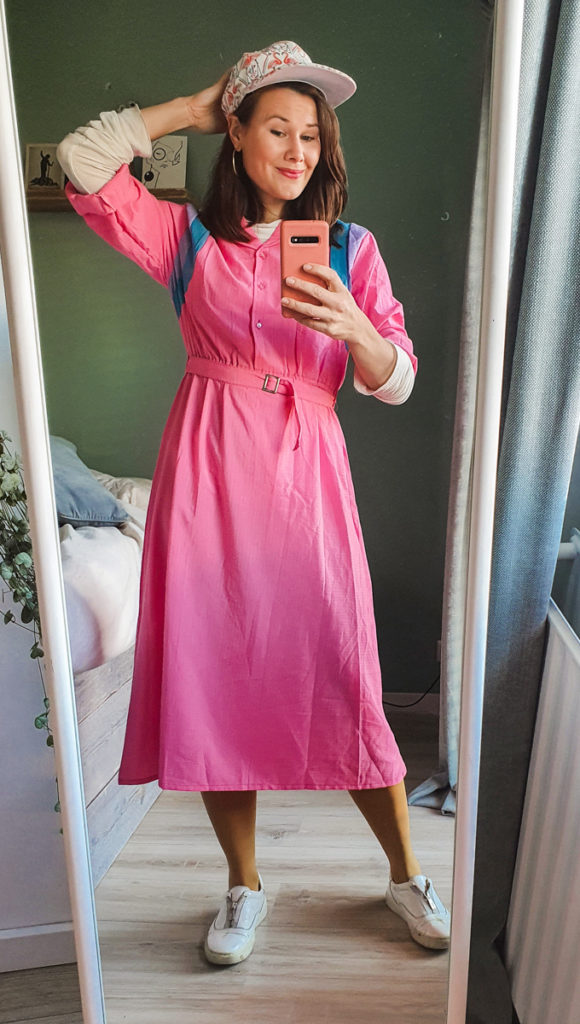
Instead of trying to tone it down, I decided to support its personality. White sneakers. A white cap. A white turtleneck layered underneath to break up the intensity and give the eye a place to rest. The white functions almost like punctuation—pauses in a very loud sentence.
The dress itself carries pink and blue. So I let those hues echo gently rather than compete. I rolled up the sleeves for a touch of nonchalance, as if to say: yes, this is bright, but I’m not taking it too seriously.
And then, yellow tights.
They are not logical. They are not necessary. But they are exactly the small rebellion the outfit needs. A spark inside the spark.
Color has always had a cultural charge. In the 1980s, neon wasn’t just aesthetic; it was energy, optimism, a hyper-visual response to political tension and economic uncertainty. When the world feels unstable, sometimes we answer with saturation.
Wearing this dress at a festival isn’t just about being playful. It’s about allowing yourself to take up visual space. To resist the quiet pressure to blend in.
In everyday life, especially as women, we’re often taught to calibrate. Not too loud. Not too bright. Not too noticeable. A festival disrupts that discipline.
And so does this dress.
When I wear it in this context, I don’t feel ridiculous. I feel amplified. And there is something liberating about leaning into that amplification instead of apologizing for it.
2. The Quirky Office: Discipline Meets Drama
The second experiment was almost the opposite question: can this dress survive fluorescent lighting?
Workspaces carry their own unspoken dress codes. Even in creative industries, there’s a thin line between expressive and distracting. Between stylish and unserious.
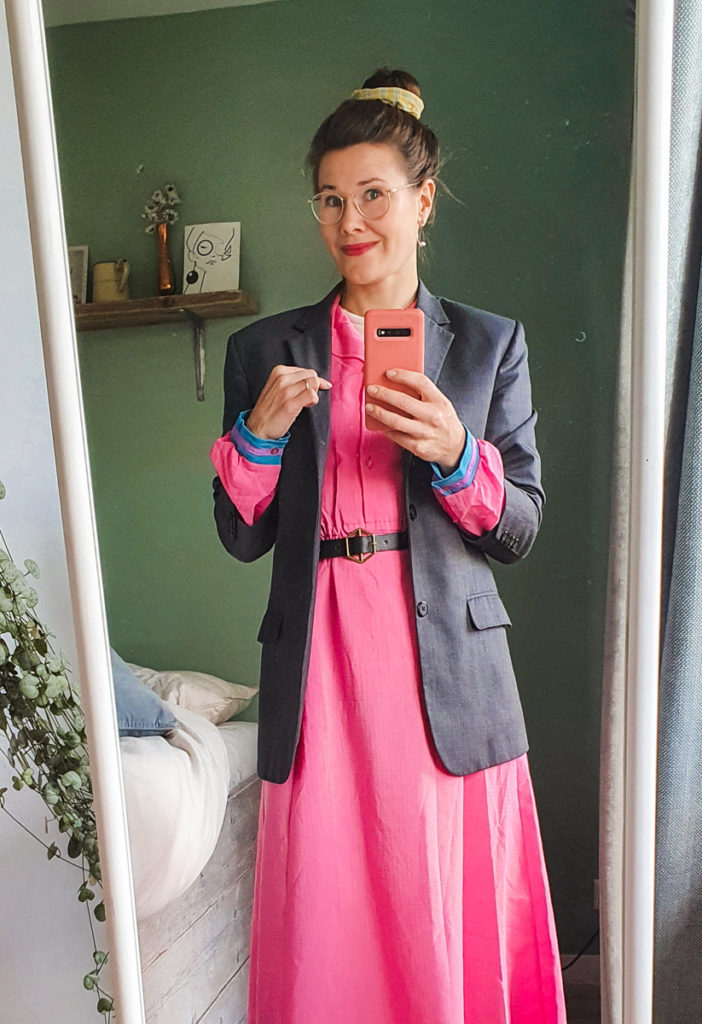
So I tried something that felt almost ironic at first. I borrowed my boyfriend’s grey blazer. Structured. Slightly oversized. Neutral in that serious, northern-European way.
The moment I put it on over the pink, something shifted.
The blazer is a cultural artifact. Historically tied to male authority, corporate environments, rationality, control. When women adopted tailored jackets in the twentieth century, it wasn’t simply about fashion—it was about access. Access to rooms, to conversations, to power.
Layering that history over a loud, playful dress creates tension. And tension is interesting.
I replaced the original pink belt with a black one to sharpen the silhouette and connect it visually to the blazer. I left the ends of the dress sleeves peeking out from under the jacket—tiny flashes of rebellion. Glasses. A high bun. A scrunchie that subtly echoes the dress without overpowering it.
The result is not neutral. It’s not “professional” in the bland sense. But it’s balanced.
What I like about this version is that it refuses the binary. It refuses the idea that seriousness requires dullness, or that creativity excludes structure.
The blazer doesn’t suppress the dress; it frames it. And the dress prevents the blazer from becoming stiff.
In a broader sense, this is what so much of contemporary style is negotiating: how to move between roles without erasing parts of yourself. The modern workday is no longer confined to one physical space. We move between meetings, cafés, home offices. Our clothes follow.
Wearing this outfit, I feel slightly mischievous. There is something satisfying about knowing that beneath the grey restraint lives a saturated pink core.
It reminds me that professionalism and personality do not have to cancel each other out.
3. Sporty Nostalgia: When Eras Collide
The third approach leaned into contrast even more directly.
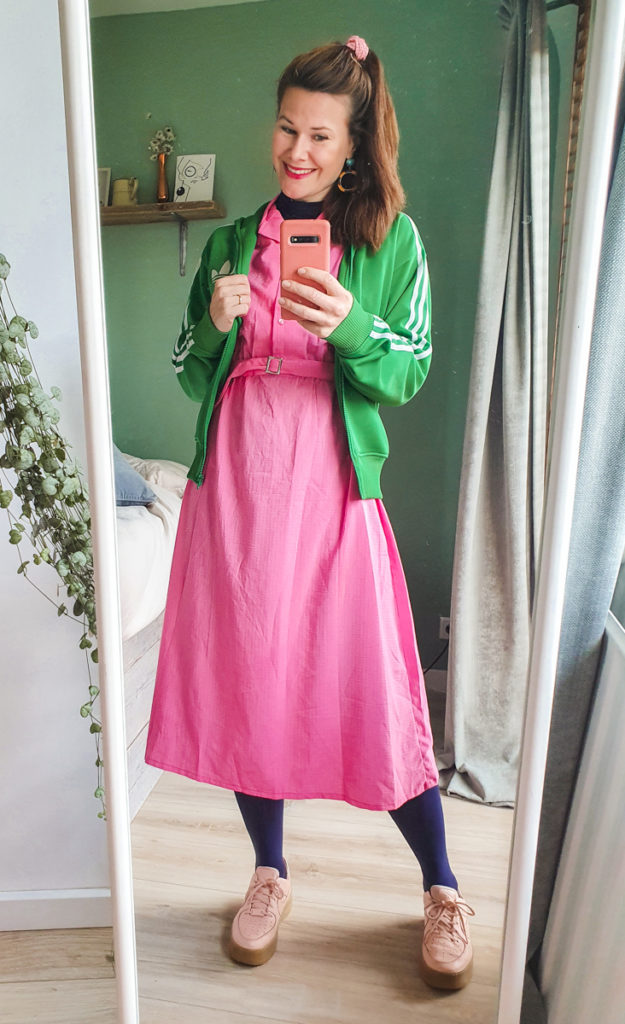
I took out an old Adidas track jacket. Navy with white stripes. The kind of piece that seems to exist in every decade without ever fully disappearing.
Sportswear has had a long journey from gym-only to everyday uniform. In the 1990s and early 2000s, the merging of athletic and casual dress signaled a shift in how we think about bodies and public space. Comfort became visible. Movement became aesthetic.
Putting a sporty jacket over a dress with a fifties-inspired silhouette feels almost contradictory. Cinched waist meets straight zip. Structured skirt meets functional nylon.
But that friction is precisely what makes it compelling.
I added a dark blue turtleneck and matching tights to create a base layer that ties into the jacket. Pink sneakers and a scrunchie bring the look full circle, echoing the dress without drowning it.
There is something slightly nostalgic about this version. A hint of Spice Girls. A hint of family photo album. A whisper of hair spray and pop choruses.
And yet, it doesn’t feel costume-like. It feels current precisely because it’s self-aware. We no longer wear sportswear to signal athletic ambition alone; we wear it to signal fluidity. To suggest that we might move, at any moment, between roles.
This outfit doesn’t aim for harmony. It aims for dialogue.
And that, I’ve realized, is often the secret to styling difficult pieces. Stop trying to make everything agree. Let them argue a little.
Why Bother?
At this point, you could reasonably ask: why invest so much thought into one pink dress?
Because how we treat our clothes mirrors how we treat other parts of our lives.
When something feels awkward or excessive, we often push it aside. We look for something easier. More adaptable. More “normal.”
But there is value in staying with the awkwardness. In experimenting.
Styling one piece in multiple ways isn’t just a creative exercise; it’s a small act of sustainability. When you expand the possibilities of what you already own, you reduce the impulse to buy something new for every mood, every occasion, every identity shift.
Fast fashion thrives on the idea that each garment has a single, predefined purpose. A festival dress. An office dress. A casual dress.
This pink dress resists that categorization. It insists on complexity.
And in learning to style it differently, I’m also practicing a kind of personal flexibility. I am not just one version of myself. I am not just serious or playful, sporty or structured. I contain contradictions.
Clothes can reflect that.
The Fear of Being “Too Much”
There’s another layer to all of this, and it’s less aesthetic.
For a long time, I was afraid of being “too much.” Too visible. Too colorful. Too opinionated. Too intense.
Pink—especially loud pink—carries its own cultural baggage. It’s been coded as frivolous, childish, unserious. At the same time, in recent years, it has been reclaimed as a color of power and irony.
Wearing a dress like this is not neutral. It attracts attention. It disrupts the safe invisibility that darker, quieter tones provide.
Each of the three versions negotiates that fear differently.
At the festival, I dissolve into a collective spectacle. My pink is just one among many.
At the office, I shield it with grey authority, letting it peek through strategically.
In the sporty version, I mask it with irony and nostalgia.
None of these approaches erase the boldness. They contextualize it.
And perhaps that’s what styling really is: not changing who you are, but adjusting the frame through which you are seen.
An Invitation
If you have a piece in your wardrobe that intimidates you—something too patterned, too bright, too dramatic—don’t immediately decide it was a mistake.
Ask yourself:
What happens if I exaggerate it?
What happens if I neutralize it?
What happens if I clash it with something unexpected?
You might discover that the problem wasn’t the garment. It was the narrow story you allowed it to tell.
This pink dress is still strange. It is still loud. It still refuses to behave.
But it no longer feels like a challenge I failed to solve. It feels like a conversation I’m still enjoying.
And maybe that’s the point.
Not to master your wardrobe. Not to tame every piece into versatility.
But to stay curious. To let your clothes surprise you. To accept that sometimes the loudest item in the room is the one that teaches you the most about yourself.