There is something deceptively simple about a skirt.
It is, structurally speaking, just fabric suspended from the waist.
And yet.
Few garments carry so much historical weight, so many coded messages, so many silent negotiations between body and culture.
A skirt can read as school uniform or seduction. As corporate efficiency or rural nostalgia. As rebellion. As modesty. As ceremony. As leisure.
It can make you feel entirely yourself.
Or faintly disguised.
For years, I thought I “wasn’t a skirt person.” Which is strange, considering half the planet has been wearing some version of wrapped or draped lower garments for millennia. Togas. Sarongs. Kilts. Hanboks. Sari pleats moving like architecture.
Trousers, historically, are the late arrival.
But modern Western dressing did something peculiar: it framed the skirt as either hyper-feminine or hyper-formal. Sweet or serious. Rarely neutral.
Learning how to wear a skirt, for me, was less about mastering silhouettes and more about dismantling that inherited tension. It wasn’t a styling problem. It was a posture problem. A permission problem.
Still — structure helps.
Let’s talk about the architecture first.
The Pencil Skirt: Discipline in Fabric
The pencil skirt is all intention.
It begins at the waist. It tapers. It ends around the knee. Clean lines. No excess. No theatrics.
Historically, its rise coincides with women entering corporate spaces in the mid-20th century — spaces originally tailored, quite literally, for men. The pencil skirt allowed a kind of visual conformity. Controlled. Composed. Professional.
It says: I am here to work.
But that same containment can feel restrictive if worn unconsciously. The key is proportion.
Because it narrows toward the knee, the upper half must balance it. A structured blazer amplifies its authority. A soft knit tempers it. A silk blouse introduces movement against its rigidity.
Shoes matter more than we admit. A sharp heel intensifies its formality. A flat or low boot can make it modern and almost minimal.
The pencil skirt doesn’t forgive poor fit. Too tight and you look constrained. Too loose and it loses its spine.
When it fits, though — when it truly fits — it can make you stand taller without trying.
It is less about sex appeal than about line.
And line is power.
Denim Skirts: The Democratic Option
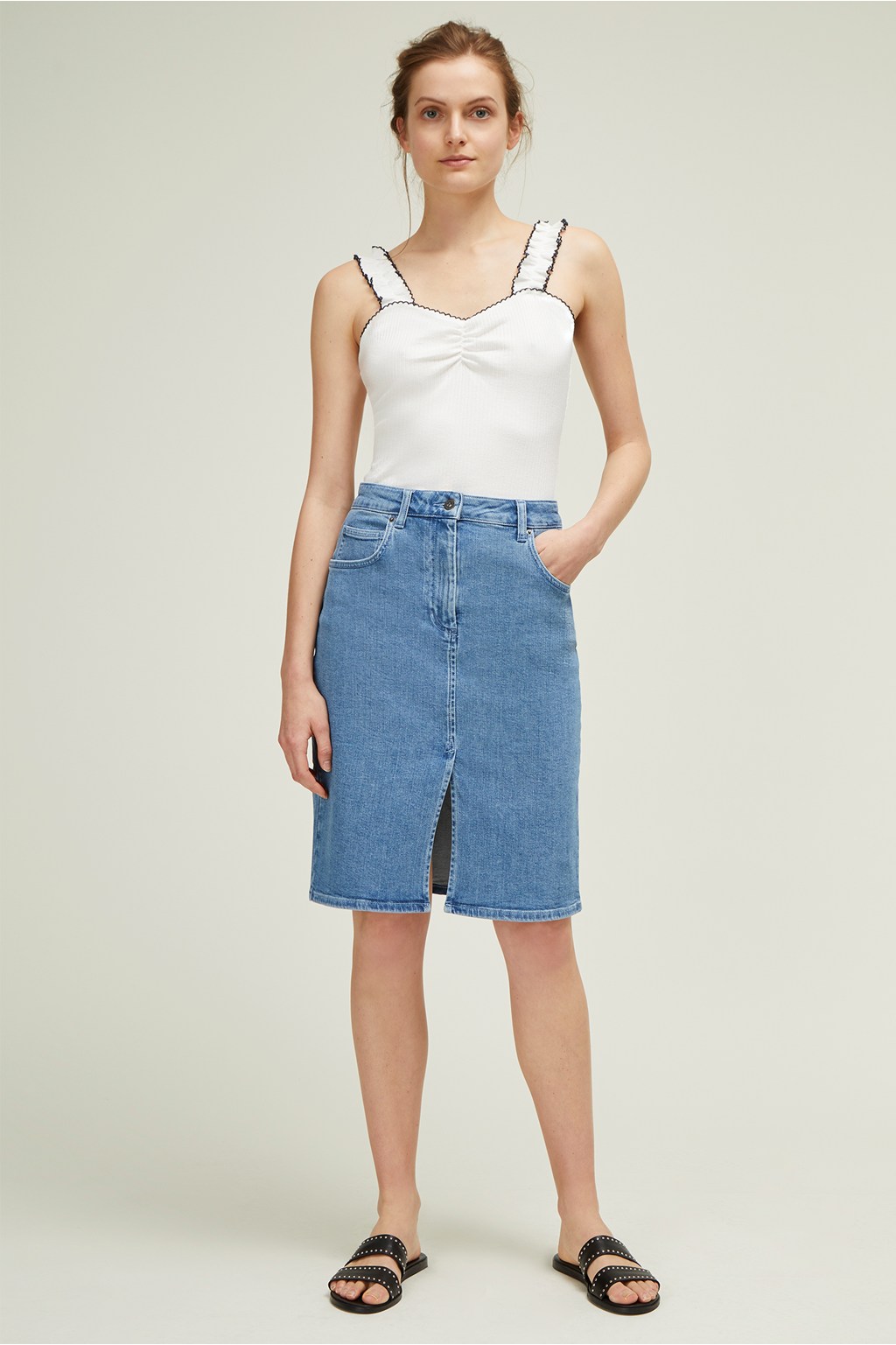
Denim skirts are pencil skirts that went outside and touched grass.
They carry none of the corporate stiffness. They belong to sidewalks and weekends and long walks where you forget about your reflection.
The beauty of denim is its neutrality. It absorbs whatever you pair it with.
White shirt? Crisp, almost French.
Graphic tee? Casual, irreverent.
Oversized knit? Softly undone.
Button-down tucked in? Slightly retro.
Because denim holds structure, it grounds the outfit. Which means you can experiment above it without tipping into costume.
There’s also something culturally subversive about denim in skirt form. Denim was historically workwear — laborer’s fabric. Durable. Practical. Democratic. Turning it into a skirt collapses the binary between “feminine” and “functional.”
That collapse is quietly radical.
Length matters here. Mini denim skirts lean youthful. Knee-length feels timeless. Midi denim can feel unexpectedly elegant when paired with something refined.
If you feel intimidated by skirts, start here.
Denim does not judge.
A-Line Skirts: Geometry That Flatters
The A-line skirt is perhaps the most forgiving silhouette ever invented.
Fitted at the waist, gently flaring outward, it creates a visual balance that works on most bodies. The shape itself is stable. Structured at the top, open at the bottom.
It echoes mid-century design — Dior’s post-war silhouettes that reintroduced volume after fabric rationing. It feels nostalgic without being dated.
Because it widens as it falls, it invites pairing with something closer to the body above. A tucked sweater. A slim blouse. Even a fitted turtleneck.
But rules are not laws. An oversized sweater half-tucked can feel modern and relaxed.
The A-line skirt is often recommended as a “safe” choice.
I don’t love that word.
Nothing about clothing should feel like risk mitigation.
Instead, think of it as cooperative. It works with you. It doesn’t demand attention. It allows you to experiment elsewhere — color, texture, accessories.
Sometimes stability is what allows creativity.
The Full Skirt: Movement as Mood
Now we enter drama.
A full skirt — whether knee-length or longer — carries volume. It moves when you move. It occupies space.
Historically, volume signified wealth. More fabric meant more expense. Ball gowns. Petticoats. Structured underlayers. Status was measurable in circumference.
Today, a voluminous skirt can feel playful rather than aristocratic. Especially when styled unexpectedly.
A crisp button-down tucked into a full skirt nods to vintage silhouettes. Add sneakers, and suddenly it’s contemporary.
Belts matter here. They anchor the waist and prevent the volume from overwhelming you.
The secret to wearing fullness without feeling swallowed is contrast. Fitted top. Sleek hair. Minimal jewelry.
When everything is voluminous, the body disappears.
When one element is voluminous, the body becomes the axis around which fabric rotates.
There is joy in twirling. We outgrow that joy too quickly.
The Midi: The Intellectual Hemline
Midi skirts end mid-calf — a length that confuses many people.
It can shorten the leg visually. It can feel conservative. It can feel awkward if proportions are off.
But when done right, the midi is quietly sophisticated.
High-waisted midis elongate the lower body. Pairing them with heels or pointed flats extends the line further. Even boots that meet the hem can create a continuous silhouette.
The midi emerged strongly in the 1940s and again in the 1970s — eras of social shift. There is something thoughtful about it. Less exposed than a mini. Less dramatic than a maxi. It sits in between.
That in-between space often reads as intellectual rather than performative.
Knit midi skirts in winter layered with tall boots feel grounded and practical. Silk midis with structured tops feel gallery-ready.
The midi demands intention. But it rewards it.
Tulle: Softness Reclaimed
Tulle carries childhood baggage.
We associate it with tutus, fairy costumes, saccharine pink layers. But adult tulle — longer, subtler — can be surprisingly nuanced.
Its transparency and volume create a tension between fragility and presence.
Styling determines everything.
With heels and a fitted blouse, it leans formal. With boots and a knit sweater, it becomes almost ironic — softness worn deliberately in a world that doesn’t always value softness.
There’s something quietly political about that.
Wearing tulle as an adult says: I am not afraid of whimsy. I am not afraid of lightness.
And in a culture that often equates seriousness with severity, that’s a subtle form of resistance.
The Maxi: Bohemia and Beyond
Maxi skirts reach the ankles — sometimes further. They move like weather.
Loose, breezy, often patterned, they evoke bohemian imagery. 1970s counterculture. Festival fields. Global textile influences.
But maxis aren’t just boho clichés.
A monochrome maxi skirt in structured fabric can feel architectural. A pleated maxi can feel almost minimalist. A linen maxi can feel coastal and restrained.
Because of their length and volume, maxis pair best with fitted or cropped tops. Otherwise, the silhouette risks becoming shapeless.
But shapelessness can also be intentional. There is comfort in garments that do not cling, do not outline, do not demand.
Maxi skirts challenge the Western obsession with displaying the body. They conceal while still flowing.
Concealment is not absence.
It is choice.
Ball Skirts: Ceremony in Motion
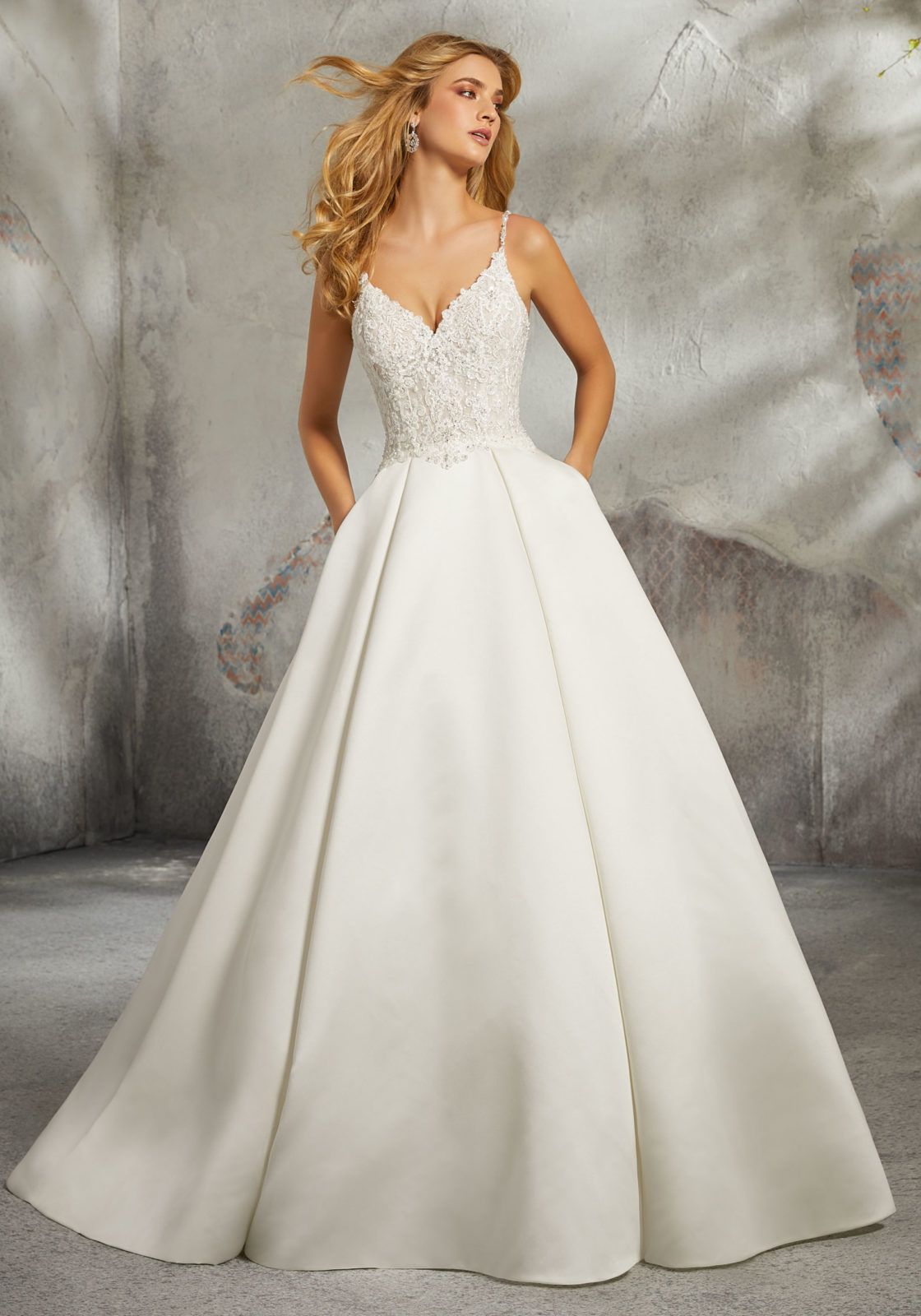
Ball skirts are maximalism unapologetically.
Long. Voluminous. Often made of structured fabrics like taffeta or satin. They belong to galas, formal events, orchestrated evenings.
And yet — I love when they’re subverted.
A denim shirt tucked into a formal ball skirt shifts the narrative. Suddenly the garment feels less costume, more expression.
Historically, ball skirts signaled elite gatherings. Ritualized social spaces. Debutante culture. Marriage markets. Visibility as currency.
Today, wearing one can feel theatrical in the best way.
Clothing occasionally deserves ceremony.
Not everything must be practical.
The Question of Body Shape
Let’s address the elephant in the fitting room.
We are often told certain skirts are “for” certain bodies.
Pear shapes should do this. Apple shapes should avoid that. Tall women can. Petite women cannot.
Most of this advice is rooted in a single goal: visual slimming.
But what if slimming is not the goal?
What if expression is?
The right skirt is not the one that makes you look smallest. It’s the one that makes you feel most aligned.
That alignment might come from proportion — high waist to elongate, A-line to balance, fitted top to define.
But it should not come from shame.
Clothing should cooperate with your body, not discipline it.
Shoes: The Silent Partner
A skirt rarely acts alone.
Shoes complete the sentence.
Heels sharpen. Sneakers casualize. Boots ground. Sandals lighten.
A midi skirt with chunky boots feels modern and slightly defiant. A pencil skirt with loafers feels intellectual rather than corporate. A maxi with minimalist sandals feels effortless.
If an outfit feels wrong, it’s often the shoes.
Change them first before abandoning the skirt.
Weather, Movement, and Reality
Let’s be honest.
Wind exists.
Stairs exist.
Public transportation exists.
Learning to wear skirts includes learning how to move in them. How to sit. How to step. How to adapt to weather without paranoia.
Layering shorts underneath. Choosing heavier fabrics on windy days. Opting for midis when mobility matters.
Practicality is not the enemy of style.
It’s the foundation of confidence.
Cultural Memory and Modern Choice
For centuries, skirts were default attire in many cultures. Trousers were associated with horseback riding, manual labor, or specific regions.
The 20th century flipped that script. Trousers became symbols of liberation for women. Practical. Powerful. Unrestricted.
So choosing a skirt today isn’t regression.
It’s multiplicity.
We can wear trousers and skirts. Structure and softness. Volume and restraint.
The modern wardrobe is not about abandoning one for the other.
It’s about expanding vocabulary.
So, How Do You Wear a Skirt?
Not by following a rigid formula.
Not by obeying body-shape diagrams.
Not by chasing trends.
You wear it by choosing the silhouette that resonates with how you want to feel that day.
Structured and sharp? Pencil.
Relaxed and grounded? Denim.
Balanced and timeless? A-line.
Expressive and fluid? Full or maxi.
Thoughtful and refined? Midi.
Whimsical and bold? Tulle.
Ceremonial and dramatic? Ball.
And then you adjust the rest — shoes, layers, posture — until it feels less like styling and more like alignment.
Because in the end, wearing a skirt is less about fabric and more about stance.
Do you shrink into it?
Or do you let it move with you?
A skirt is not a costume unless you treat it like one.
It is architecture. It is history. It is motion.
And when you find the one that feels like yours, it stops being an item in your wardrobe.
It becomes part of your language.