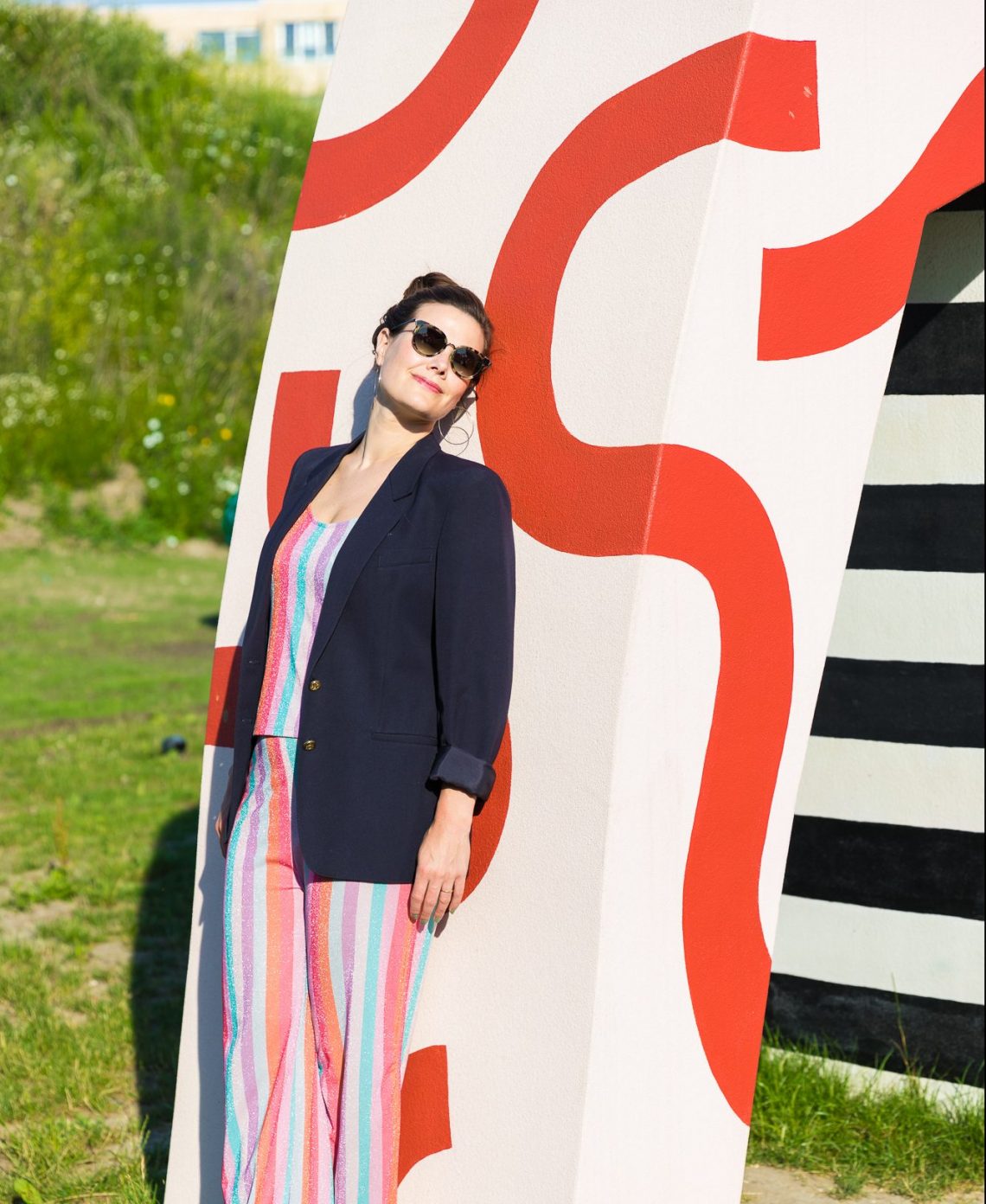
In my early twenties, I had a tragic relationship with sunglasses.
They never survived me.
I would sit on them at café terraces. Leave them in the sand at the beach. Toss them carelessly into tote bags without a case, where keys and pens performed quiet acts of destruction. Some pairs lasted a few weeks. One memorable pair didn’t even make it through a single afternoon.
I told myself I was chaotic. Distracted. Not the kind of person who could own “nice things.”
So I bought cheap sunglasses. Again and again.
When I turned thirty, my younger sister handed me her Ray-Ban aviators. Not new. Not pristine. But undeniably real. They had weight. History. A price tag I was suddenly aware of even though I hadn’t paid for them.
And something unexpected happened.
They survived me.
Not because I became less chaotic. Not because I developed superior motor skills overnight. But because I treated them differently. I used the case. I placed them carefully on tables. I checked twice before leaving a restaurant.
It was never my personality that destroyed the cheaper pairs. It was my valuation of them.
And once I understood that, I could no longer look at my wardrobe the same way.
We speak about fast fashion as if it were inherently fragile. Disposable by design. Destined to pill, shrink, unravel.
Sometimes that’s true.
But sometimes, the real reason those garments die young is because we expect them to.
We treat inexpensive clothing as temporary. And in doing so, we ensure that it becomes temporary.
There is a quiet hierarchy in our closets.
The expensive wool coat gets the padded hanger. The silk blouse is hand washed. The designer jeans are air dried flat. Meanwhile, the five-euro T-shirt is thrown into a hot wash, tumble-dried on high heat, stretched over a metal hanger while still damp.
We say fast fashion is low quality. But often, what we mean is: we don’t believe it’s worthy of our care.
This belief is not accidental. It is cultural.
Fast fashion emerged alongside an acceleration of trends. Micro-seasons. Weekly drops. New arrivals every time you refresh a website. Clothing became content—designed to feed novelty rather than longevity.
In that system, repair feels almost rebellious.
Why mend a seam when you can buy a new top for the price of a coffee? Why re-dye faded black when a fresh version hangs on the rack?
The logic is efficient. It is also deeply wasteful.
I have a black Zara dress that an ex-boyfriend gave me when I was twenty-one. It has survived breakups, relocations, different hair colors, different bodies. The straps once tore at the seams; I stitched them. The black dulled; I refreshed it with dye. It still fits into my life with quiet loyalty.
Objectively, it is fast fashion.
Subjectively, it is one of the most durable pieces I own.
I’ve also purchased second-hand pieces from H&M, Asos, Boohoo—garments that have outlived certain “investment” items simply because I washed them gently, repaired small damages early, and stored them properly.
This complicates the narrative.
Because if fast fashion is always framed as trash, we give ourselves permission to treat it as such.
And yet, behind every garment—cheap or expensive—there are hands.
A garment worker does not stitch with less skill because the brand is budget-friendly. A seamstress does not invest less concentration because the label will retail at a lower price. The labor embedded in a ten-euro shirt is still labor. The time is still time.
When we dismiss fast fashion pieces as disposable, we are indirectly dismissing that labor.
This is where the conversation shifts from fabric to psychology.
We are remarkably good at aligning our behavior with price. Higher cost signals value; value signals care. Lower cost signals replaceability; replaceability signals neglect.
It is almost subconscious.
When I owned only cheap sunglasses, I did not see them as worth protecting. They were placeholders. Temporary. Interchangeable.
When I owned Ray-Bans, they became an extension of myself.
The irony is that fast fashion garments often contain synthetic fibers that, if properly maintained, can last longer than we expect. Cotton can be rewoven. Buttons replaced. Zippers repaired. Elastic refreshed.
But we rarely try.
Because trying requires friction.
Hand washing takes time. Air drying demands patience. Sewing on a button interrupts the scrolling of a feed. Re-dyeing black fabric requires planning, a bucket, perhaps stained fingertips.
Buying new is seamless. Repairing is intentional.
And we live in a culture that privileges seamlessness.
Historically, clothing occupied a different space in daily life. Garments were fewer and more carefully maintained. Mending was a skill passed down generations. Patches were visible, even decorative. To repair was not shameful; it was practical.
Industrialization changed production. Globalization changed scale. And digital culture changed pace.
Today, the average consumer purchases significantly more garments per year than previous generations, while wearing each piece fewer times. This is not simply a moral failure; it is structural. Marketing thrives on novelty. Algorithms reward constant change. Social media flattens repetition into perceived stagnation.
Wearing the same outfit multiple times used to be normal. Now it requires either indifference or conviction.
Taking care of fast fashion clothing, then, becomes quietly radical. It interrupts the churn.
When we wash a polyester blouse on a delicate cycle instead of hot. When we avoid overloading the washing machine. When we turn garments inside out to reduce friction. When we skip the dryer and let fabric rest in air—we extend lifespan.
These are small acts. But multiplied across millions of wardrobes, they matter.
There is also the environmental dimension.
Textile production is resource-intensive. Water, energy, chemical dyes, transportation. By the time a garment reaches a store, the majority of its environmental impact has already occurred. Extending its life—even by nine months—can significantly reduce its overall footprint.
So caring for fast fashion is not about endorsing overproduction. It is about mitigating damage within an imperfect system.
This is an uncomfortable nuance. Because many of us who critique fast fashion also feel compelled to distance ourselves from it entirely. We prefer the narrative of ethical brands, slow labels, curated capsules.
But not everyone can afford high-end sustainable brands. Not everyone lives near local designers. And even those of us who aspire to “buy better” often still own fast fashion pieces from previous years.
Shaming those garments does not erase them.
What if, instead, we treated every piece in our closet—regardless of price—as deserving of maintenance?
What if we decided that the ethical act begins not only at the moment of purchase, but in the daily rituals afterward?
This requires a shift in identity.
Instead of seeing ourselves as consumers who occasionally declutter, we might see ourselves as caretakers of textiles. Temporary custodians.
It changes the way you handle a sweater. The way you fold a shirt. The way you respond to a loose thread.
A loose thread is not a death sentence. It is an invitation.
The cultural layer fascinates me. Fast fashion is often criticized as a symbol of excess. And rightly so. But there is another layer: aspiration. Accessibility. Democratization of trends.
In earlier eras, fashion innovation was limited to elites. Today, silhouettes and aesthetics move quickly across price points. This has expanded self-expression for many people.
The problem is not access. It is acceleration.
If we cannot immediately dismantle the machinery of acceleration, we can at least resist its psychological grip.
Caring for fast fashion clothing is a form of resistance against the narrative that new equals better.
It is also a quiet acknowledgment of labor dignity.
Imagine the garment worker who stitched your ten-dollar blouse. She does not see it as disposable. For her, it is a product of time and skill. If we choose to wear it twenty times instead of five, to repair it instead of discarding it, we are honoring that embedded labor in a small but meaningful way.
There is also something deeply satisfying about preservation.
I used to believe that adulthood meant upgrading everything—replacing cheaper items with “better” ones. But perhaps maturity is less about constant upgrading and more about sustaining.
The Ray-Bans taught me that.
The black Zara dress taught me that.
Even the basic H&M T-shirts that have survived years because I stopped blasting them in the dryer taught me that.
When we slow down the life cycle of our clothes, we slow something else too: our appetite for novelty.
And that appetite is not purely aesthetic. It is psychological. Novelty offers dopamine. A small thrill. A sense of reinvention.
Repair, by contrast, offers continuity.
Continuity can feel less exciting. But it builds depth.
A wardrobe full of garments you have cared for over time tells a different story than a closet constantly refreshed. It speaks of commitment. Of memory. Of evolution rather than replacement.
This is not a romanticization of frugality. Nor is it a denial that some fast fashion pieces are indeed poorly constructed. Some will fall apart no matter how gently you treat them.
But many will not.
And even those that are fragile deserve at least the dignity of an attempt.
When we stop categorizing clothing as worthy or unworthy based on price, something subtle shifts in our relationship with consumption.
We become more attentive.
And attention is a form of respect.
Respect for fabric. Respect for labor. Respect for our own resources.
I no longer blame my chaotic twenties for the graveyard of broken sunglasses. I blame my indifference.
Indifference is easy when something is cheap.
Care is a choice.
So perhaps the conversation about fast fashion needs to expand. Not only toward buying less or buying better—but toward caring more for what already exists.
Because whether a garment cost five euros or five hundred, it carries the same basic truth: someone made it.
And maybe the most sustainable thing we can do, right now, is to treat every piece in our closet as if it were a pair of Ray-Bans we intend to keep.