There is a particular kind of dress you don’t think about until you realize you’ve worn it three times in one week.
Not because you are uninspired.
Not because your laundry basket is overflowing.
But because every time you stand in front of your wardrobe, it quietly raises its hand and says: Me. Again. I’ll work.
That was my experience with Alchemist.
And I didn’t expect it.
The first time I encountered the brand, I was drawn in by the name. Alchemist. It carries a faint whiff of medieval laboratories and candlelit manuscripts. Of figures hunched over beakers, chasing the impossible — the transmutation of base metals into gold.
The metaphor is obvious, but it is also strangely fitting.
Because transforming something ordinary into something precious is precisely what good design does.
Luxury Without Theatrics
Alchemist describes its mission as combining luxury fashion with an honest lifestyle.
That phrase could easily collapse into marketing fog. Luxury is often synonymous with excess — gloss, spectacle, aspirational distance. Honesty, meanwhile, suggests restraint, transparency, groundedness.
The tension between those two words intrigued me.
What does honest luxury look like?
Not the kind that announces itself with logos or exaggerated silhouettes. Not the kind that exists primarily for Instagram’s approval. But something quieter. Something integrated.
Alchemist produces two collections per year. Each collection is designed to blend with the previous ones. The silhouettes are consistent. The palette evolves gently rather than dramatically. Nothing screams “this season only.”
In an industry that thrives on obsolescence, that decision alone feels quietly radical.
Because fashion’s economic engine depends on dissatisfaction. You are meant to feel that last year’s cut, last season’s color, is slightly off.
Alchemist resists that churn.
It builds continuity.
The Alchemy of Contact
Historically, alchemists were obsessed with transformation. They believed that by combining elements in precise ways, they could elevate the mundane into the extraordinary.
There is something poetic about applying that metaphor to clothing.
Fabric and body.
Cut and movement.
Garment and context.
When these elements align, something shifts. The dress is no longer just stitched material; it becomes an extension of your posture, your rhythm, your mood.
Alchemist speaks about connection — that people are not solitary creatures, that we are intertwined with our environment. This philosophy runs beneath their material choices.
Organic cotton. Linen. Non-mulesing merino wool. GOTS-certified where possible. No leather — replaced by vegan alternatives.
Around ten percent of their collection incorporates recycled materials: linen, denim, wool. They also work with lyocell, modal, EcoVero — fibers that sit somewhere between natural and engineered. Occasionally, for durability, they blend in synthetic yarns to strengthen knitwear.
Purity is rarely practical.
Longevity sometimes requires compromise.
And I appreciate that they acknowledge this rather than pretending perfection.
Slow Fashion as Discipline
We talk about slow fashion as if it is inherently virtuous. But slowness is not aesthetic. It is structural.
Producing two collections per year. Designing pieces that integrate with past seasons. Choosing materials that endure. Avoiding leather. Limiting waste.
These are operational decisions.
But slow fashion is also psychological.
It invites the wearer to reconsider consumption patterns. To buy fewer pieces. To wear them repeatedly. To invest emotionally as well as financially.
I saved for my Alchemist dress.
That detail matters.
When you save for something, you project anticipation into it. You imagine scenarios. You justify the expense internally.
By the time I ordered it from Wolf & Storm last year, it had already occupied space in my mind.
And when it arrived, it did not disappoint.
The Dress That Refuses To Be Occasion-Specific
There is a particular trap in wardrobe building: the “special” item.
The dress reserved for dinners. The coat too elegant for everyday errands. The blouse that demands a reason.
Alchemist’s strength lies in avoiding that trap.
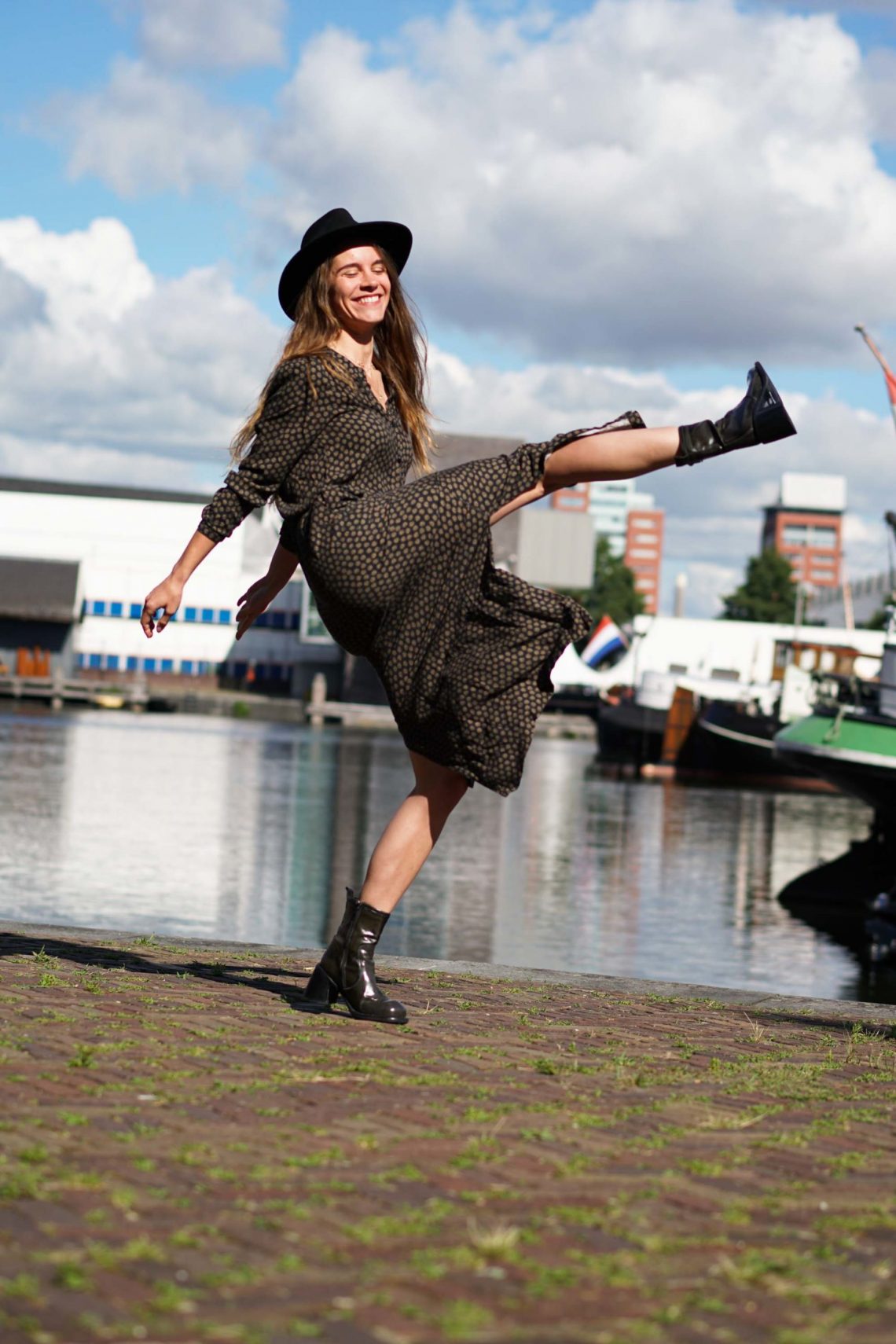
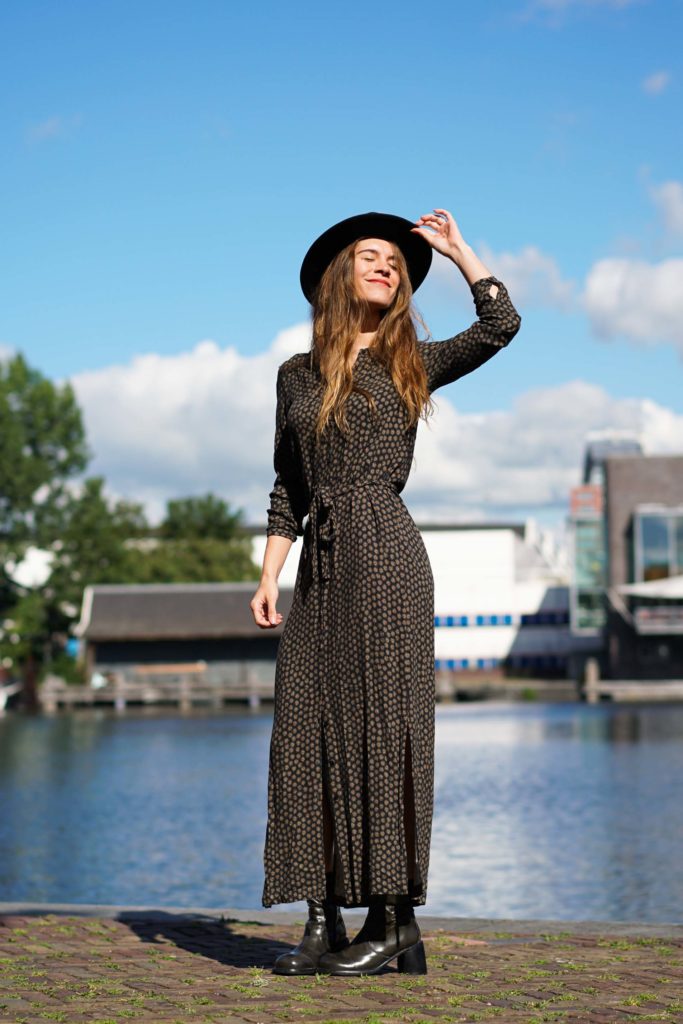
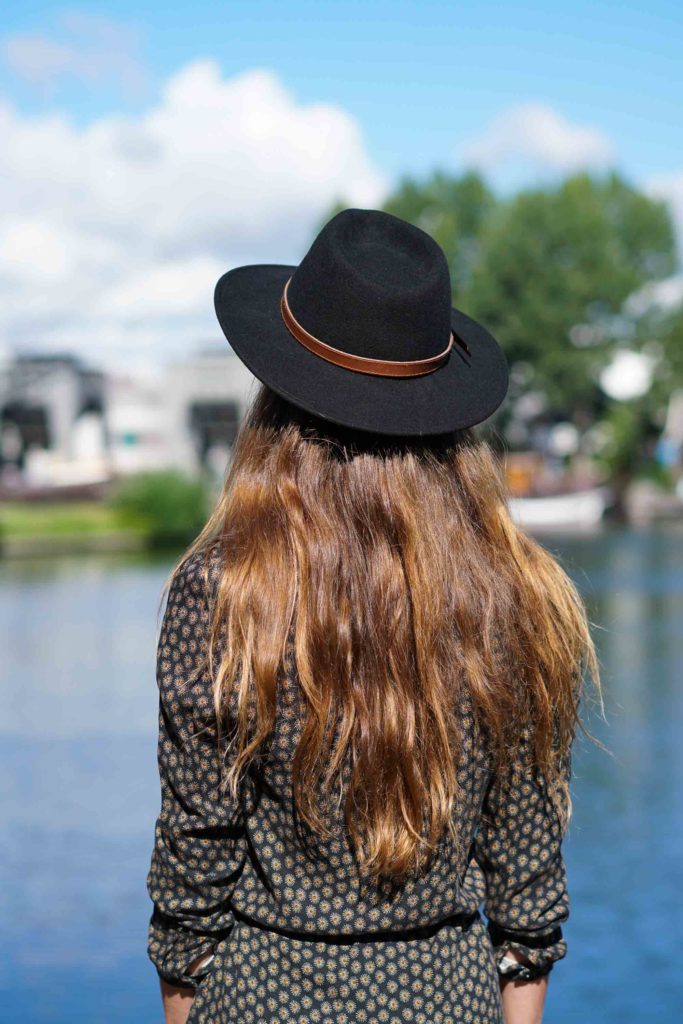
The dress I bought — simple in silhouette, fluid in movement — has become one of the most versatile pieces I own.
On a typical Dutch summer day, it works on its own. Bare legs. Sandals. Wind moving through fabric.
In winter, it adapts. Tights. A thin T-shirt layered underneath. A sweater thrown over the shoulders. It does not protest the cold; it collaborates.
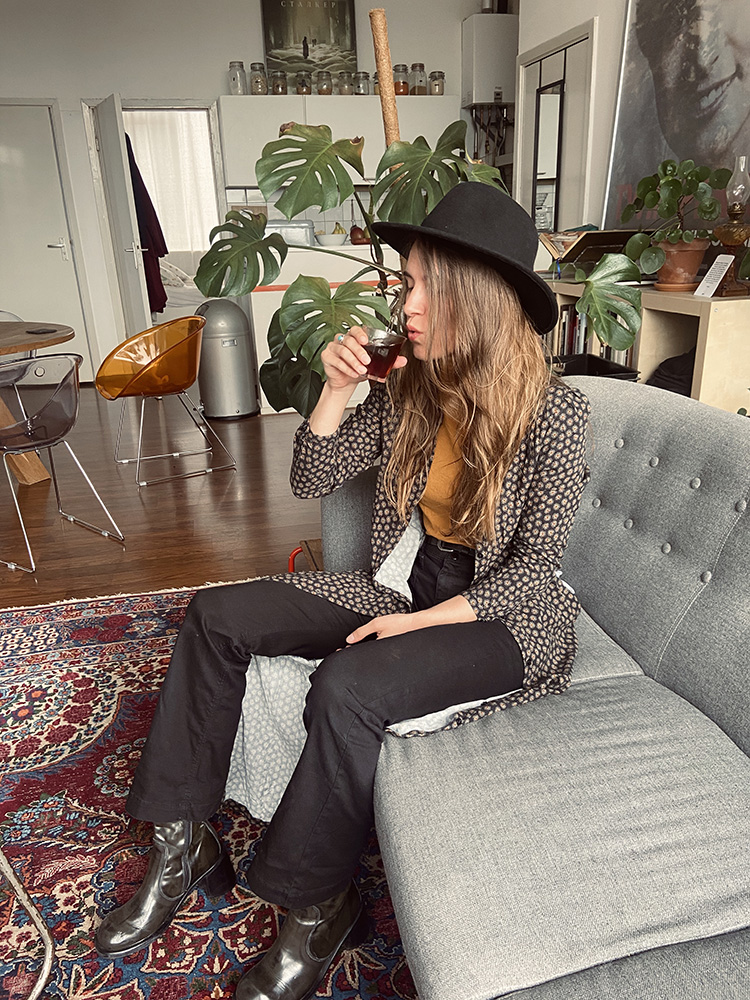
And when I feel nostalgic for the seventies — which happens more often than I care to admit — I wear it open like a kimono. Flared jeans. Turtleneck. Hat. Suddenly the dress becomes outerwear, a frame rather than a focal point.
Few garments tolerate this level of reinterpretation.
That adaptability is not accidental. It is engineered into the cut.
Material Memory
There is something distinct about natural fibers.
They hold warmth differently. They crease differently. They age differently.
Organic cotton softens with repetition. Linen breathes and folds with a kind of nonchalance. Merino regulates temperature in ways synthetic blends often struggle to mimic.
When you wear these materials, you become subtly aware of your body’s interaction with climate. You feel airflow. You sense weight.
Fast fashion often insulates us from sensation. Polyester traps heat but masks discomfort with stretch. Acrylic imitates wool but lacks its responsiveness.
Alchemist’s commitment to natural fibers reintroduces tactility.
And tactility grounds you.
Sustainability Without Aesthetic Sacrifice
One persistent myth about sustainable fashion is that it must look earnest.
Earth tones. Minimalism. A kind of visual austerity meant to signal virtue.
Alchemist avoids that pitfall.
The pieces are refined. Clean lines. Balanced proportions. Colors that feel intentional rather than trendy.
They do not scream sustainability.
They simply embody it.
This distinction matters because fashion is language. If sustainable clothing becomes visually coded as morally superior but aesthetically dull, it alienates those who crave beauty.
Alchemist understands that beauty is not indulgent. It is communicative.
On Not Being Underdressed
There is a quiet confidence that comes from wearing clothing that feels aligned.
Not extravagant.
Not attention-seeking.
Just… right.
My Alchemist dress has carried me through mundane Tuesdays and slightly elevated Sundays. Through casual coffees and evenings that unexpectedly stretched longer than planned.
I never feel underdressed in it.
There is enough structure to hold form. Enough fluidity to remain comfortable.
This balance is surprisingly rare.
Clothing often tilts too far toward effortlessness (and reads careless) or too far toward polish (and feels performative).
The sweet spot — where comfort and presence intersect — is difficult to engineer.
But when achieved, it becomes addictive.
The Cultural Moment of “Less, But Better”
We are living through a strange contradiction.
On one hand, hyper-consumption continues at staggering speed. Micro-trends circulate on TikTok and expire within weeks. Shein hauls accumulate millions of views.
On the other hand, there is a growing fatigue.
People are beginning to question the logic of closets filled with unworn garments. The environmental cost. The psychic clutter.
Brands like Alchemist sit at that crossroads.
They do not position themselves as revolutionaries. They are not aggressively anti-fast-fashion in tone. Instead, they offer an alternative model — one built on longevity and cohesion.
“Less, but better” is an old mantra. But it requires discipline.
And discipline is not glamorous.
It means resisting impulse. Choosing continuity over novelty.
Alchemist’s restrained production schedule supports that discipline.
The Paradox of Transformation
If we return to the alchemical metaphor, there is an interesting inversion.
Medieval alchemists sought to turn base metals into gold — to create something rare and materially valuable.
In contemporary fashion, perhaps the real alchemy is subtler.
It is taking something as ordinary as a dress — cotton, linen, thread — and imbuing it with enough intention that it becomes indispensable.
Not because it is rare.
But because it is integrated.
Transformation here is not about spectacle. It is about alignment.
When cut, fabric, ethics, and personal style intersect, something shifts. The garment transcends trend and becomes infrastructure.
On Compromise and Transparency
Alchemist’s occasional use of synthetic fibers in knitwear deserves acknowledgment.
Purists might object. But durability often requires reinforcement. A small percentage of polyamide or polyester can prevent sagging, prolong wear, reduce pilling.
Sustainability is rarely absolute.
It is a negotiation between ideals and practicalities.
I prefer brands that admit this complexity rather than presenting an illusion of perfection.
Transparency builds trust.
And trust is essential if slow fashion is to scale beyond niche markets.
Wearing Intention
Since buying that dress, I have found myself reaching for it not out of habit, but out of trust.
I trust its fit.
I trust its durability.
I trust that I will not feel misaligned in it.
That trust is built through repetition.
And repetition is how clothing becomes personal.
We often speak of “investment pieces” as financial decisions. But perhaps they are emotional ones. Investments in coherence. In reducing decision fatigue. In cultivating a wardrobe that functions like a toolkit rather than a costume archive.
Alchemist’s approach supports that mindset.
The Quiet Gold
In the end, the gold Alchemist pursues is not literal.
It is experiential.
It is the moment when you step outside and realize you are neither adjusting straps nor smoothing hems nor second-guessing proportions.
It is the relief of feeling appropriately dressed without overthinking it.
It is the knowledge that the garment will survive another season. And another.
In a world obsessed with transformation through accumulation, there is something deeply reassuring about transformation through refinement.
Turning cloth into gold, perhaps, was never about chemistry.
It was about care.
And sometimes, that care is as simple as a well-cut dress in a fabric that breathes — waiting patiently in your wardrobe, ready to raise its hand again tomorrow.