There is a particular heartbreak that happens in early autumn.
You open the wardrobe. You reach for that sweater — the one that carried you through last winter, the one that felt like a reliable friend — and suddenly it looks… tired.
Not torn.
Not stained.
Just… covered in tiny, stubborn pills.
Those small knots of tangled fiber have a cruel psychological effect. They whisper: You are worn out. You are old. You belong in the “home clothes” pile.
And so the sweater gets demoted. Not because you stopped loving it. Not because it failed structurally. But because visually, it lost its composure.
For years, I accepted this as inevitable. Sweaters pill. That’s life. Especially wool blends. Especially anything remotely soft. I would wear them less. Then only at home. Then not at all.
Until I realized something mildly embarrassing.
Pilling is not decay.
It is friction.
And friction can be managed.
What Pilling Actually Is (And Why It Feels So Offensive)
Let’s demystify it for a second.
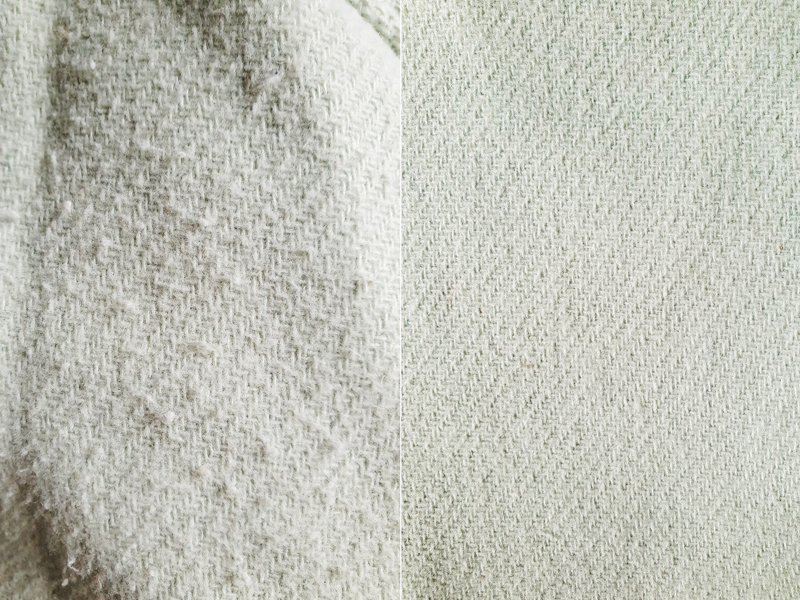
Pills are simply broken fibers that have tangled together into small balls on the surface of the fabric. They happen when yarn rubs against itself — under arms, along sides, where bags brush against hips.
Soft fibers are especially prone to it. Wool. Cashmere. Even high-quality knits.
In fact — and this is the part that surprised me — sometimes better fabrics pill more easily in the beginning because they are less tightly spun and more natural.
Pilling is not automatically a sign of cheapness. It is a sign of movement.
But culturally, we have been trained to read surface irregularity as decline.
We live in an aesthetic that worships smoothness. Perfect finishes. Seamless surfaces. Think about it — we filter our skin, polish our floors, steam our clothes into submission. Anything textured begins to look “neglected.”
So when a sweater pills, we don’t just see fiber friction.
We see deterioration.
And deterioration makes us uncomfortable.
The Worst Thing You Can Do (I Did It Too)
For years, I would sit on the couch and absentmindedly pull pills off with my fingers.
It feels satisfying for exactly three seconds.
Then you realize you’ve created a tiny bald spot.
Because when you pull, you’re not just removing the pill. You’re breaking more fibers. Which means… more pills later.
It’s like scratching a mosquito bite. Temporary relief. Long-term damage.
That’s when I learned: pilling isn’t something you tear off.
It’s something you shave.
The Five-Minute Ritual That Changes Everything
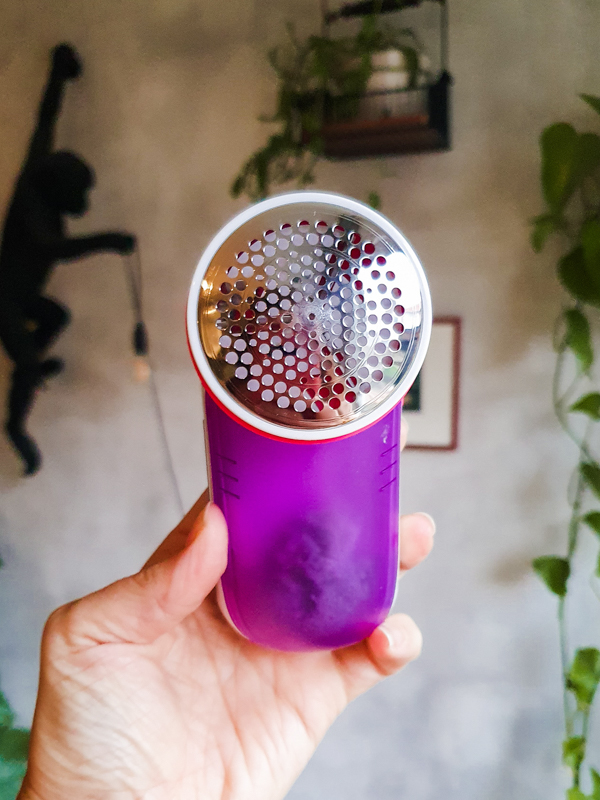
Enter: the fabric shaver.
The first time I used one, I felt like I had discovered a domestic superpower.
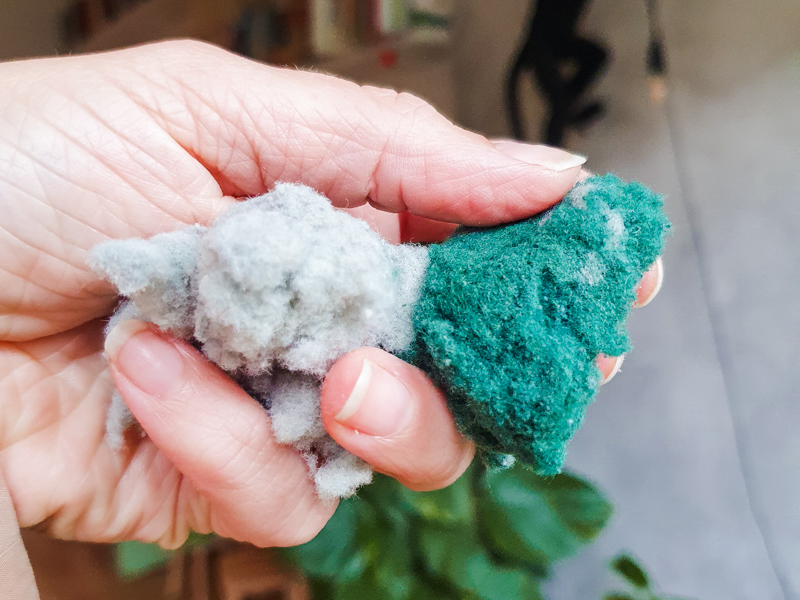
You glide it gently over the surface of your sweater, and the tiny rotating blades trim the pills cleanly without pulling at the fibers underneath. The device collects the lint inside a small compartment, so you can see exactly what you’ve removed.
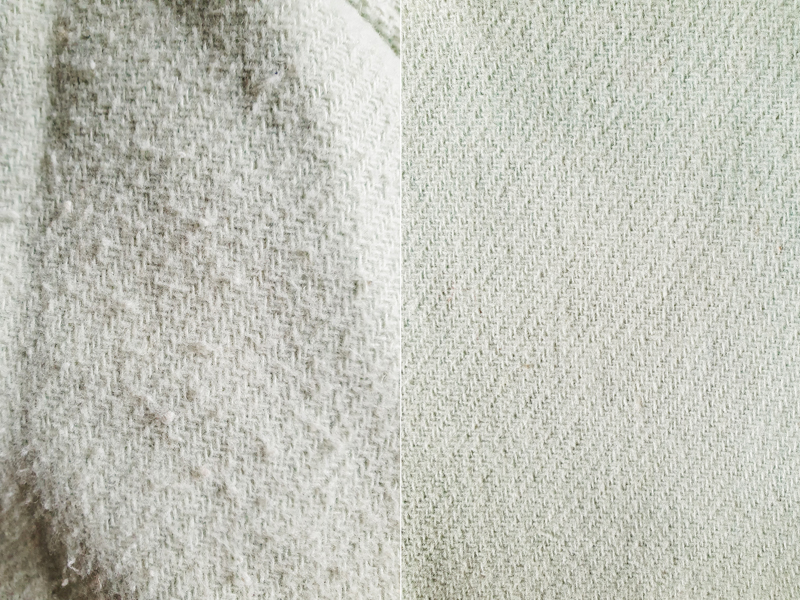
Within minutes, the fabric looks smooth again.
Not new.
But revived.
And that distinction matters.
Revival feels different from replacement. It carries memory.
The first garment I rescued was a dark green crewneck I had found in a vintage shop years ago. It had that perfect slightly oversized fit. The right neckline. The kind of piece you don’t stumble upon twice.
But it had started to look tired. Underarms fuzzy. Sides rough.
Five minutes later, it looked intentional again.
I remember holding it up and thinking: So this is what we’ve been throwing away?
Why This Is Bigger Than Sweaters
On the surface, removing pilling is maintenance.
But culturally, it’s rebellion.
Fast fashion has conditioned us to interpret small signs of wear as expiration dates. A loose thread? Replace. Minor fading? Replace. Surface fuzz? Replace.
It’s cheaper — financially and emotionally — to buy new than to maintain.
But that “cheapness” is deceptive.
Because maintenance builds relationship.
When you repair something, clean something, shave something — you invest attention. And attention is the currency of care.
Historically, clothing was maintained, not replaced. Sweaters were darned. Coats were brushed. Shoes were polished.
The post-war boom in synthetic fibers and mass production shifted that logic. When garments became cheaper than labor, repair became irrational.
Why spend time fixing when you can spend $20 replacing?
But here’s the quiet truth: quality perception is often surface-deep.
A pilled sweater looks low-quality. A smooth one looks refined. The structure underneath hasn’t changed. Only the texture.
Which means five minutes can visually elevate your entire wardrobe.
Razor Blade vs Fabric Shaver (And Why I Choose Ease)
Yes, technically, you can use a razor.
People have been doing it for years. Lay the garment flat. Stretch the fabric. Gently skim the surface.
It works.
But it requires concentration. Patience. And you still have to manually remove the lint as you go.
A small electric fabric shaver is faster. More controlled. Less stressful. It trims evenly and collects the debris automatically.
And there is something deeply satisfying about emptying that little lint container afterward. Proof of transformation.
It feels slightly addictive.
Almost meditative.
A strangely domestic version of those oddly satisfying internet videos — the before-and-after of surface renewal.
The Psychology of “Looking Old”
We need to talk about why pilling bothers us so much.
Because it’s not just about clothes.
We associate fuzziness with aging. With decline. With loss of sharpness.
Smooth equals youth. Crisp equals new. Texture equals wear.
In a culture obsessed with anti-aging — for skin, for furniture, for architecture — it’s no wonder we struggle with textile imperfection.
But fabrics, like people, are meant to live.
A completely pristine sweater that has never moved, never rubbed, never carried a bag across its shoulder — that sweater has never been part of a real life.
Pilling is evidence of presence.
The problem isn’t that it exists. The problem is that we mistake it for irreversibility.
When you shave a sweater and watch it regain clarity, you realize something subtle:
Aging isn’t always decay.
Sometimes it’s maintenance deferred.
How I Actually Do It (The Exact Five-Minute Method)
Here’s my ritual:
- Lay the garment flat on a hard surface (table, bed with a book underneath).
- Smooth it out gently — no stretching.
- Turn on the fabric shaver and glide it lightly across the surface in small circular motions.
- Avoid pressing too hard. Let the device do the work.
- Focus on high-friction areas first: underarms, sides, cuffs.
- Empty the lint compartment when it fills.
- Give the sweater a final shake and brush off any loose fibers.
That’s it.
Five minutes.
Sometimes less.
And suddenly, pieces I mentally categorized as “home-only” are back in rotation.
It feels like discovering forgotten wealth in your own closet.
Extending Garment Life Is Not Just Practical — It’s Ethical
Every garment carries labor.
Cotton farmers. Wool shearers. Spinners. Dyers. Pattern cutters. Sewers.
Even the most affordable sweater has a human chain behind it.
When we discard clothing because of surface pilling, we erase that chain prematurely.
The environmental cost of textile waste is enormous. Landfills filled with garments that were structurally intact but aesthetically neglected.
We often talk about sustainability in grand gestures — capsule wardrobes, investment pieces, responsible brands.
But sustainability also lives in micro-actions.
Shaving a sweater instead of replacing it.
Choosing repair over disposal.
Extending wear by one season. Then another.
It sounds small.
But multiplied across millions of closets, it’s significant.
A Strange Kind of Satisfaction
I won’t pretend there isn’t a slightly guilty pleasure element.
Watching pills disappear under the gentle hum of a fabric shaver is oddly gratifying.
It’s neat. Controlled. Immediate.
Unlike most life improvements, which take months or years, this one is visible in seconds.
Before. After.
Transformation without drama.
There is something deeply calming about restoring order at a micro level.
Maybe that’s why I enjoy it so much.
It feels like reclaiming agency.
Why We Don’t Talk About This More
Because maintenance isn’t glamorous.
Buying new is exciting. Unboxing is photogenic. Hauls are clickable.
Shaving a sweater is quiet.
It doesn’t scream consumption. It whispers preservation.
But preservation has a different kind of elegance.
There is sophistication in owning fewer pieces and maintaining them well.
When I see someone wearing a beautifully kept knit — smooth, structured, clearly loved — it communicates care.
Not trendiness.
Care.
And care is rarer.
What Happens When You Start
Once you begin removing pilling, you start seeing your wardrobe differently.
Instead of “this looks old,” you think, “this needs five minutes.”
Instead of browsing for replacements, you reach for maintenance.
It shifts the narrative from scarcity to stewardship.
And interestingly, it changes how you buy.
When you know you can maintain a piece, you’re more willing to invest in better fibers. Because you trust longevity.
The relationship between ownership and responsibility becomes visible.
The Broader Lesson
A pilled sweater taught me something unexpectedly philosophical.
We are quick to discard what merely looks tired.
We underestimate the power of small restoration.
We confuse surface wear with structural failure.
But most things — garments included — do not collapse all at once. They erode slowly. And often, they can be renewed with minimal effort.
Five minutes of attention can shift perception entirely.
That’s true in closets.
And sometimes beyond them.
So the next time you pull out a sweater and feel that flicker of disappointment — pause.
Don’t demote it.
Don’t pull at the fibers.
Lay it flat. Turn on the shaver. Watch the texture transform.
Five minutes later, you’ll be holding the same garment.
But it will look composed again.
And you might feel slightly more composed too.