There is something slightly humiliating about being known by an algorithm.
You scroll for five minutes, pause half a second too long on a linen blazer, and suddenly your entire digital life rearranges itself around “conscious fashion.” Organic cotton. Slow tailoring. Ethical minimalism. The internet has decided who you are.
Apparently, I am the woman who wants sustainable wide-leg trousers.
And to be fair — I do.
That is how I met Hund Hund. Not through a friend. Not in a concept store in Kreuzberg. But in the soft glow of Instagram, where desire is engineered with surgical precision.
They appeared once. Then again. And again. After the fifteenth time, I felt almost obligated to click. Persistence, after all, deserves attention.
What I found was not just another “eco” label wrapped in beige marketing. It was something quieter, more deliberate — and distinctly Berlin.
Berlin Minimalism, but Make It Honest

Hund Hund is a Berlin-based fashion brand founded by designer Isabel Kücke and Australian filmmaker Michael Hoole. The pairing already tells you something: fashion meets narrative. Garments with structure, and a story about why that structure exists.
The aesthetic is clean, unisex, unfussy. Think sharp lines without aggression. Think tailoring that does not scream power, but implies it.
It would be easy to compare them to brands like Filippa K, COS or Acne Studios — that restrained Scandinavian modernity with a Berlin edge. But comparisons are lazy shortcuts. What struck me was not resemblance. It was intention.
A significant part of their collections is produced using surplus premium fabrics — cashmere, silk, linen, modal, textured wool — materials originally sourced by other retailers and left unused. Instead of producing more, they redirect what already exists.
This practice is not revolutionary in theory. Upcycling and deadstock usage have been discussed for years in sustainable fashion circles. But theory and execution are two different things.
The difference lies in whether sustainability is aesthetic or structural.
With Hund Hund, it feels structural.
The Seduction of “Affordable Luxury”
Let’s talk about the phrase “affordable sustainable luxury.”
It is an uncomfortable combination of words.
Luxury traditionally relies on scarcity and exclusivity. Sustainability insists on responsibility and reduction. To merge them requires a delicate balance: the product must feel elevated, but not inflated.
I was in “need” of wide-leg suit pants. And yes, I use quotation marks intentionally. Fashion rarely fulfills biological needs. It fulfills psychological ones. A pair of wide-leg trousers promises competence. Control. A certain adult coherence.
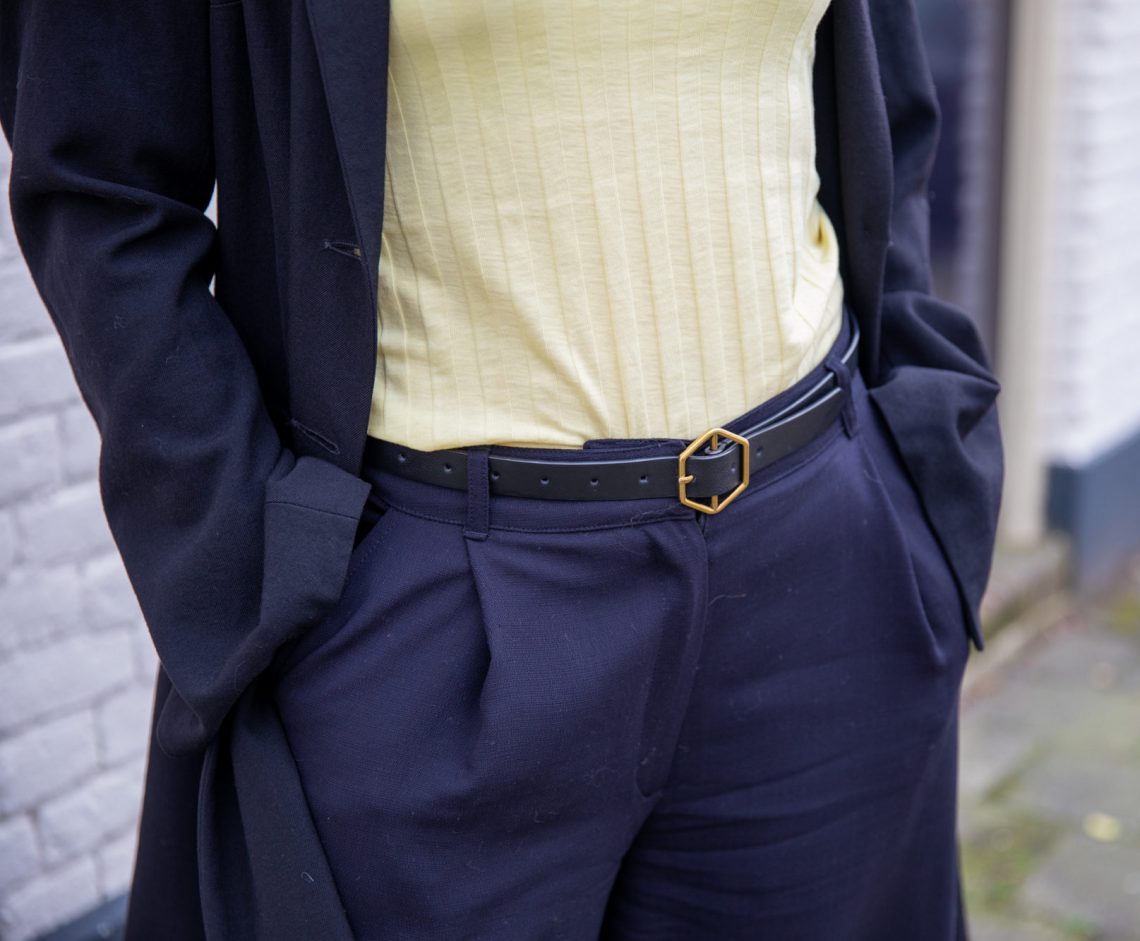
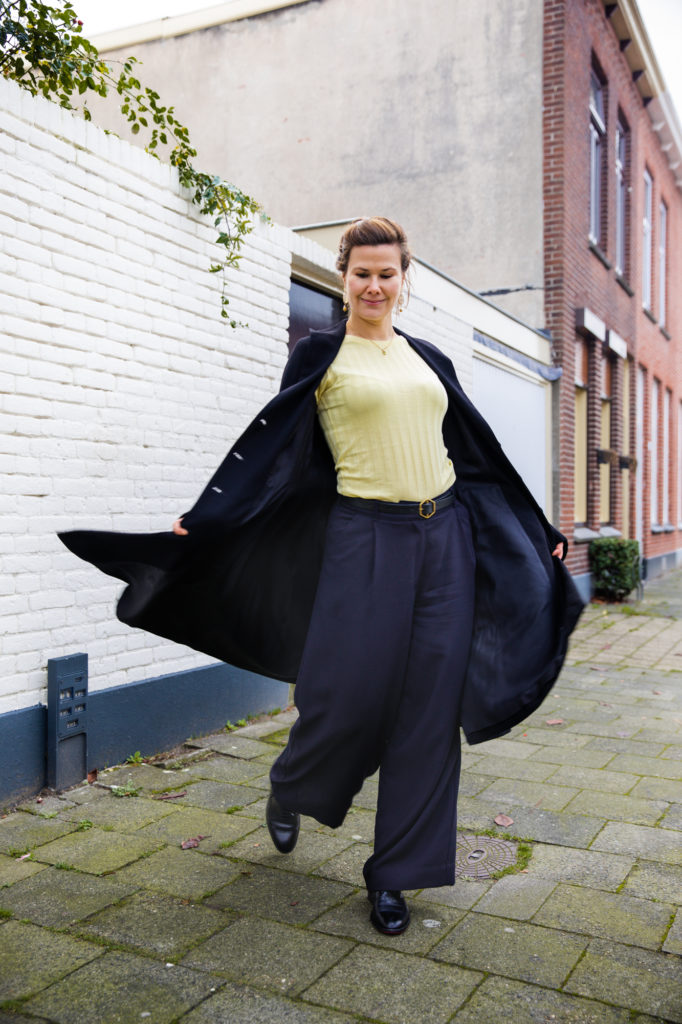
After reading the fabric descriptions and studying the size guide like I was preparing for an exam, I ordered the Ragna Pants in navy textured wool, along with a vanilla wide-ribbed top.
Before clicking “checkout,” however, I noticed something unusual: shipping and returns were not free.
This is where many consumers hesitate.
We have grown accustomed to frictionless consumption. Order three sizes. Return two. Try at home as if the entire logistics chain were your private dressing room.
Hund Hund refuses that model.
The founders openly state that covering shipping and return costs contributes to overconsumption and unnecessary environmental impact. If customers bear those costs, they will — theoretically — order more consciously.
It is a small but meaningful shift of responsibility.
Of course, it also means you measure carefully. You hesitate. You think.
And perhaps that hesitation is precisely the point.
When Clothing Fits — Literally and Conceptually
The Ragna Pants arrived in minimal packaging. No unnecessary plastic. No theatrical branding.
I tried them on with a quiet anxiety that only online shoppers understand.
They fit.
Perfectly.
The waist sat exactly where it should. The wool had weight without heaviness. The silhouette elongated without exaggeration. I normally fluctuate between S and M, and I ordered size 38 — which confirmed my suspicion that when in doubt, sizing slightly up in structured tailoring often works better.
Every time I wear those navy trousers, someone comments. Not loudly. Not theatrically. But consistently.
“Those look expensive.”
“Great fit.”
“Where did you get them?”
Quality, when it is real, does not need a logo.
The vanilla ribbed top, however, revealed something else: Berlin’s comfort with transparency. The fabric is slightly translucent. Not poor quality — the material has remained intact after multiple washes — but a design choice.
Berlin fashion does not always prioritize modesty. It prioritizes concept.
And here is where personal taste enters. I prefer slightly more opacity. But I also appreciate that the brand does not dilute its design language to satisfy everyone.
Radical Transparency — or the Promise of It
What intrigued me most was not the trousers. It was the pricing philosophy.
Hund Hund became known for offering detailed price breakdowns of production costs: fabric, labor, logistics, margins. A gesture toward what they called “radical transparency.”
In an industry notorious for opaque supply chains and inflated markups, this approach felt almost confrontational.
Fashion traditionally thrives on mystique. We are rarely invited to see behind the curtain.
To reveal cost structures is to destabilize illusion.
At the moment, their website mentions that radical transparency is “coming soon” again. Perhaps this reflects restructuring. Perhaps recalibration. Transparency, after all, is easy to claim and difficult to maintain.
But the intention remains significant.
Because transparency is not just about numbers. It is about trust.
And trust is a fragile currency in fashion.
Berlin as a Cultural Context
To understand Hund Hund, one must understand Berlin.
Berlin does not perform glamour in the Parisian sense. It performs conviction.
The city has always attracted artists, outsiders, thinkers, and those allergic to polished conformity. Post-wall Berlin cultivated an aesthetic of intentional rawness. Concrete, oversized silhouettes, monochrome palettes. Style that signals independence rather than wealth.
In that landscape, a minimalist unisex brand using surplus luxury fabrics feels native.
Berlin fashion often exists in tension: anti-capitalist spirit within a capitalist system; subculture aesthetics sold globally; authenticity mediated through Instagram.
Hund Hund navigates that tension carefully.
They operate within the market, yes. They sell garments online. They rely on digital visibility. And yet, their structural decisions — limited runs, deadstock fabrics, paid shipping — push gently against the culture of excess.
This is not revolution. It is recalibration.
And recalibration matters.
The Ethics of Desire
There is an uncomfortable question beneath all of this:
Can fashion ever be truly sustainable?
Clothing production consumes water, energy, labor. Even deadstock fabrics were originally produced within an industrial system.
Perhaps sustainability in fashion is not about purity, but about reduction and responsibility.
About asking: Do I need this? Will I wear this? Will this piece remain relevant beyond one season?
My Ragna Pants have become a staple. Casual with sneakers. Structured with heels. Soft with knitwear. Authoritative with a blazer.
Versatility is sustainability’s quiet ally.
The more contexts a garment can inhabit, the longer it lives.
And longevity may be the most radical form of luxury.
Between Cynicism and Hope
It is easy to be cynical about “ethical fashion.” Marketing departments have learned the language of sustainability. Green is profitable.
But it is also important not to dismiss every attempt at structural change.
Hund Hund is not perfect. No brand is. But they embody an effort to balance aesthetics, responsibility, and economic reality.
Their decision to avoid free returns challenges consumer habits.
Their use of surplus fabrics reduces unnecessary production.
Their openness about pricing (when fully implemented) invites accountability.
And perhaps most importantly, their designs are desirable.
Because if sustainable clothing is not beautiful, it will not be worn.
If it is not worn, it is not sustainable.
Why I Still Think About Them
Months after that initial algorithmic encounter, I still reach for those navy trousers with a small sense of satisfaction.
Not because they are trend-forward. Not because they are viral.
But because they feel aligned.
Aligned with my desire for quality.
Aligned with my discomfort about overconsumption.
Aligned with a quieter, more intentional way of engaging with fashion.
The algorithm may have introduced me to Hund Hund. But the decision to purchase — and to keep — was mine.
And that distinction matters.
Because in a world where our desires are constantly nudged and shaped by invisible systems, choosing consciously becomes a subtle act of autonomy.
Berlin has always been a city negotiating identity — between history and reinvention, austerity and experimentation.
Hund Hund reflects that negotiation in fabric form.
Clean lines. Honest materials. A refusal to pretend that shipping is free or that sustainability is effortless.
Between algorithms and integrity, there is a narrow path.
Walking it requires attention.
Wearing it requires intention.
And perhaps that is the quiet promise of brands like Hund Hund: not perfection, but participation in a different conversation about what clothing can be — and what it should cost, not only financially, but ethically.
The next time an ad appears in my feed, promising conscious consumption, I will still feel that familiar mix of skepticism and curiosity.
But now I know that sometimes, behind the targeted marketing, there is something worth examining.
Not because it is perfect.
But because it is trying.
And in fashion — as in cities — trying may be the most honest starting point.