Last week I did something that, on paper, sounds faintly unhinged.
I spent a small, almost ceremonial amount of money on socks.
Not a chaotic five-pack grabbed while balancing toothpaste and oat milk at the checkout. Not the emergency pair you buy because you’re traveling and somehow forgot how mornings work. No. I bought socks the way one buys a coat they intend to keep for a decade. Slowly. Deliberately. With a kind of private seriousness.
And I have not regretted a single cent.
Which is strange, because socks occupy the lowest rung in our clothing hierarchy. They are the understudies of the wardrobe. The invisible laborers. We invest in coats that announce our presence and boots that command pavement, but socks? Socks are an afterthought—until they aren’t.
The older I get, the less patience I have for garments that quietly sabotage my day. A waistband that pinches. A shoe that blisters. A knit that pills into oblivion after three washes. And yet for years—years—I continued to slide my feet into thin, shapeless, morally indifferent cotton tubes that stretched, twisted, sagged, and developed existential holes by month three.
There is something culturally revealing about the way we treat socks. We live in a time of hyper-visibility—Instagram outfits, capsule wardrobe checklists, seasonal color analyses. Everything is curated for the gaze. Socks, hidden under hems and boots, exist outside that spectacle. They are private. And so we neglect them.
But private does not mean unimportant.
If anything, the opposite.
I remember, embarrassingly clearly, the first time I encountered what I now think of as Higher Sock Consciousness.
It was a winter holiday, a family gathering thick with wrapping paper and too much dessert. An aunt—one of those women who understands fiber content the way other people understand astrology—handed me a small box. Inside was a single pair of socks. Just one.
I’ll admit: I was confused. Socks, singular? On that budget?
Then I saw the brand. I felt the knit. I slipped them on later that evening in my childhood bedroom, still faintly smelling of old books and radiator heat. And my feet—my poor, long-suffering feet—experienced something close to revelation.
They were structured without being stiff. Soft without collapsing. They held the arch. They cushioned the heel. They did not twist halfway through the day like a passive-aggressive ribbon. They simply… stayed.
It is absurd how transformative that felt.
You would think that moment would have reformed me instantly. That I would have sworn off supermarket multipacks and synthetic blends with names that sound like space-age polymers.
But habits are stubborn. Convenience is seductive. Price tags whisper soothing lies.
So I continued to buy the cheap ones. The ones that stretch out by lunchtime. The ones that develop a philosophical hole at the big toe just as winter sets in. The ones that leave elastic indentations around the ankle like faint accusations.
And yet, through all those cycles of purchase-and-disappointment, that one gifted pair endured. Year after year. Wash after wash. The knit dense and resilient, the shape intact, the comfort consistent. A quiet rebuke from the back of the drawer.
There’s a peculiar lesson there about longevity versus abundance. We talk endlessly about investing in quality, about buying fewer and better, about sustainability as a moral framework. But we often apply those principles only to visible items—the coat, the bag, the boots.
Socks escape the ethical spotlight.
Which is ironic, because they are in intimate contact with us all day. They absorb the small frictions of our movement. They regulate temperature. They protect skin. They are infrastructure.
When I finally decided to overhaul my sock drawer, it was less a shopping trip and more a recalibration.
I asked myself a simple question: Why does every other part of my body deserve thoughtful materials, but not my feet?
Why am I willing to pay for breathable linen shirts, responsibly sourced denim, supportive footwear—and then sabotage that ecosystem with a flimsy, anonymous sock?
The answer, I think, is cultural inertia. We’ve inherited the idea that socks are disposable. Replaceable. Generic.
But the body doesn’t experience them that way.
A good sock is architectural. It understands tension. It distributes pressure. It manages moisture. It anticipates movement. It does not collapse under the weight of a long commute or a day on concrete floors.
The difference between a mediocre sock and a very good one is subtle at first. It’s not fireworks. It’s not drama. It’s the absence of irritation. The absence of readjustment. The absence of that low-level awareness that something is slightly off.
And when something is not slightly off, your day shifts—almost imperceptibly—toward ease.
I bought different categories, because my life is not one-note.
There are the athletic ones: reinforced heel, firm arch compression, breathable panels that actually breathe rather than pretend. These are for long walks, for airports, for the kind of Saturdays that turn unexpectedly ambitious.
There are the at-home ones: thicker, warmer, indulgent without being sloppy. The kind that make hardwood floors feel less hostile in winter. The kind you notice when you curl your feet under you on the sofa.
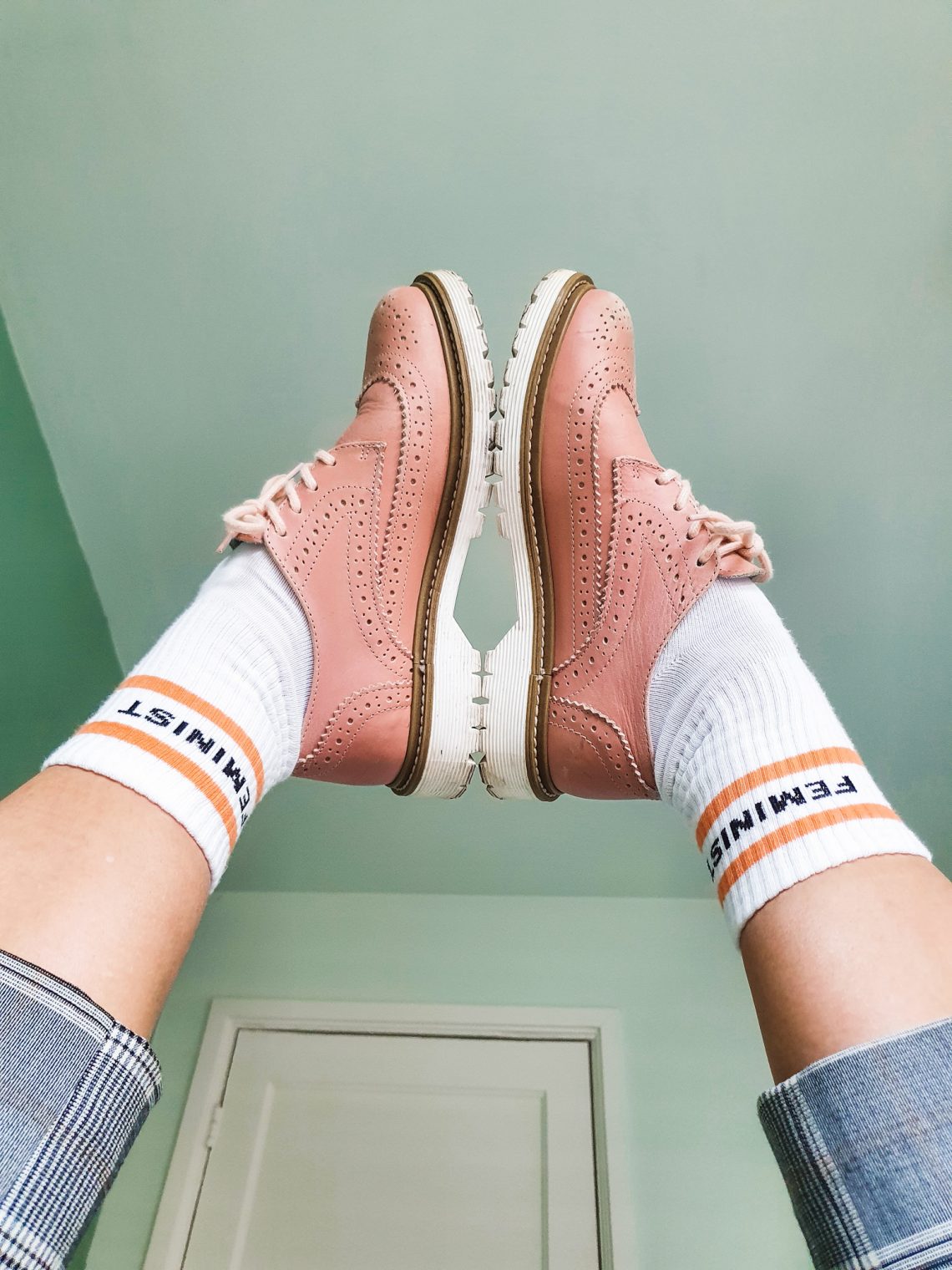
There are the decorative ones: subtle ribbing, interesting weaves, colors that peek out just enough beneath a cropped trouser. Not novelty. Not gimmick. Just quiet detail.
And then there are the black basics—those disciplined, uniform pairs that slide seamlessly under tailored pants and ankle boots. They are not attention-seeking. They are reliable. They show up and do their job.
This might sound like an excessive taxonomy for something that lives mostly below the hemline. But classification is care. Attention is care.
There is also, inevitably, the sustainability question.
We are drowning in textile waste. Fast fashion cycles churn out garments designed to fail. The humble sock—cheap, synthetic, poorly constructed—is a repeat offender. They stretch out, thin out, wear through, and are replaced without ceremony.
When you buy seven five-euro pairs over two years, you’ve spent the same as one well-made pair that might last seven. Only the cheaper ones will fragment into landfill confetti.
It is not moral perfection I’m after. It is reduction. Fewer purchases. Longer lifespans. Materials that degrade with dignity rather than disintegrate.
There is something deeply satisfying about opening a drawer and seeing cohesion instead of chaos. No more orphaned socks waiting for their lost twin. No more limp cuffs. No more emergency purges.
Just rows of intention.
And here’s the unexpected part: investing in socks changed the way I move.
When your feet feel supported, you stand differently. When they are warm but not overheated, you focus differently. When there is no seam digging into your toe, you forget about your feet entirely—which is, paradoxically, the highest compliment you can give a sock.
We underestimate the cumulative power of small discomforts. A waistband that pinches all day. Shoes that rub. Socks that slide down. Each one is minor. Together, they form a low hum of irritation.
Remove one element from that hum, and the silence is noticeable.
There is also something quietly radical about caring for parts of yourself that no one sees.
In a culture obsessed with outward presentation, tending to the hidden feels almost subversive. Good socks are not performative. They are not content. They are not algorithm-friendly.
They are for you.
I think about soldiers being told to keep their feet dry. Not because it is glamorous. Not because anyone will applaud them for it. But because function precedes flourish. Survival precedes style.
We may not be marching through swamps, but we are navigating our own terrains—subways, offices, sidewalks slick with rain. The body still matters. The details still matter.
It’s easy to romanticize investment pieces when they photograph well. It’s harder to romanticize a sock.
But perhaps that is precisely why it deserves attention.
Since my overhaul, I’ve retired the worst offenders. Some became cleaning rags. Some were beyond redemption. I kept a few as cautionary artifacts—thin, misshapen reminders of false economy.
The new pairs, meanwhile, have settled into my routines without drama. They wash well. They retain shape. They do not twist into philosophical crises mid-afternoon.
And every time I pull them on, there’s a small, almost smug satisfaction. Not because they are expensive. Not because of the brand. But because they represent a choice to extend care downward—to the foundation.
We talk endlessly about building a wardrobe that reflects who we are. But perhaps the more interesting question is: does your wardrobe support how you live?
Support is not metaphorical when it comes to socks. It is literal. Structural. Material.
Maybe this is what adulthood looks like—not the abandonment of pleasure, but the refinement of it. The shift from quantity to quality. From spectacle to substance. From five mediocre pairs to one excellent one.
If that sounds overly philosophical for a drawer of cotton and wool, so be it.
Clothing is never just clothing. It is habit, economy, ethics, sensation, memory. It is the way we negotiate the world through fabric.
And sometimes, the most transformative negotiations happen at ankle height.
So yes, I spent a serious amount on socks.
And no, I will not be returning to the checkout-line multipacks.
My feet have standards now.
And frankly, they deserve them.